
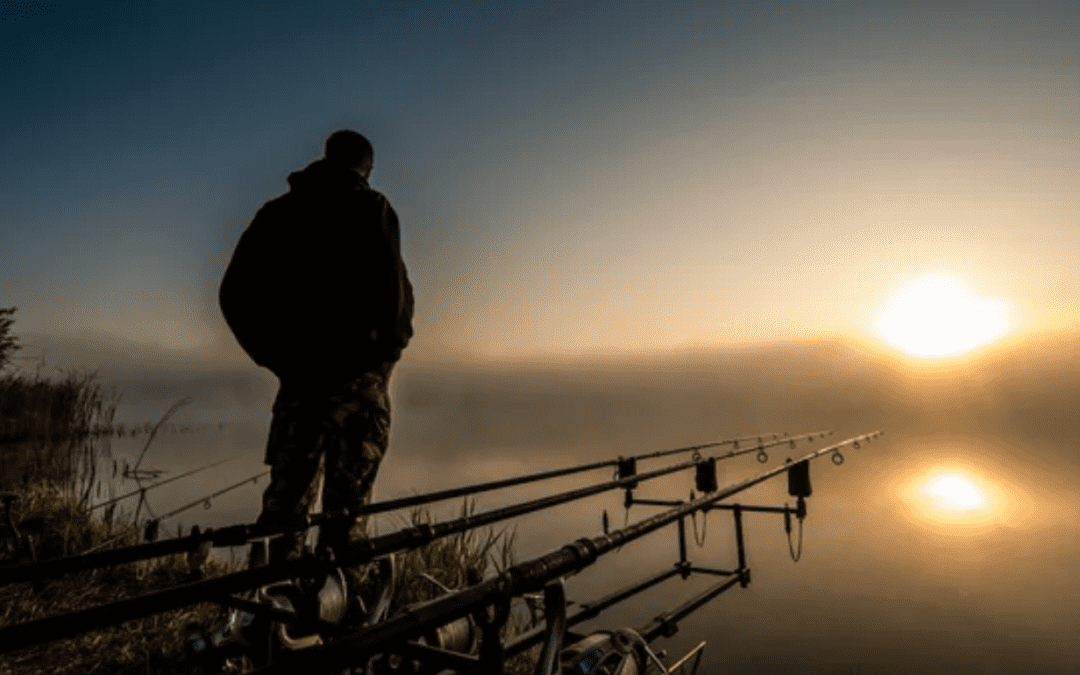
Gravel pits represent the pinnacle of UK carp fishing. The fish are often large, the water is clear, the pressure is real but not overwhelming, and the rewards for those who read the water correctly are exceptional. They’re also significantly harder to fish than commercial day-tickets — the skills required to find and catch fish consistently on a gravel pit will make you a better angler on every water you fish.
Why Gravel Pits Are Different
Gravel pits are formed by sand and gravel extraction. The removal of material creates a highly irregular lakebed — gravel bars, islands, channels, deep holes, plateaus, and silt pockets all within relatively small areas. This varied bottom structure is exactly what carp use to their advantage: they can be held in one area of the lake while the rest appears completely devoid of fish.
The water is typically extremely clear in gravel pits, especially on mature pits with established plant and invertebrate communities. This means carp can see rigs, lines, and bait from a significant distance — stealth, finesse, and presentation quality matter far more than on coloured commercial waters.
Finding Carp on a Gravel Pit
Physical Features to Look For
Gravel pits reward anglers who invest time in reading the water before fishing it. The most reliable fish-holding features on any gravel pit:
- Gravel bars: The most sought-after spots. Where the gravel was deposited by extraction machinery, shallow bars formed. Carp patrol these bars, feeding on snails, caddis larvae, and naturals. The end (or “nose”) of a gravel bar is typically the highest-productivity point
- Drop-offs: Where the lakebed drops sharply from a shallow shelf to deeper water. Carp patrol along the drop-off edge, particularly in warm weather when they’re moving between shallow and deep water daily
- Deep holes and channels: In cold weather, deep water provides thermal stability. Carp retreat to the deepest accessible water in winter. Channels between bars funnel fish movement
- Marginal snags and overhanging trees: Carp feel secure near physical cover. Overhanging willows and alder trees on the margins of a gravel pit will hold fish year-round, often in surprisingly shallow water
Using a Marker Float
A marker float and lead system is non-negotiable for gravel pit fishing. Cast systematically across your intended swim and drag the lead back along the bottom, feeling the transitions between silt, weed, gravel, and clay. Record the distances and angles of key features and mark your mainline with a marker pen for repeatable accuracy.
Feature Finding With a Deeper Sonar
The Deeper Pro Plus sonar and similar castable units are particularly valuable on gravel pits where features extend beyond comfortable marker float range. They provide real-time depth readings and bottom contour mapping that would take hours with a marker float alone.
Tackle Adjustments for Clear-Water Gravel Pits
Mainline Choice
Fluorocarbon mainline — or at minimum a fluorocarbon leader — is worth using on very clear gravel pits. Its low visibility in water and dense sinking properties make it less detectable than monofilament, which can bow in the surface film and create unnatural angles. See our guide to carp fishing line for the full fluorocarbon vs mono comparison.
Hooklink and Presentation
Use longer, finer hooklinks than you would on commercial waters. A 25–30cm fluorocarbon hooklink with a Combi Rig or Blowback Rig setup allows the hookbait to move more naturally on a clear, clean gravel lakebed. Smaller hookbait sizes (12–14mm rather than 18–20mm) are less visually obvious to clear-water fish.
Lead Weight and Casting Accuracy
Gravel pit features are often at significant range — 60–120 yards is not uncommon. A longer, stiffer rod (12ft 3.5lb test curve) and a flat pear or distance lead in 3–4oz provides the casting weight for clean, accurate delivery to far-bank features. Casting accuracy matters enormously — a bait 3 yards off the end of a gravel bar catches significantly fewer fish than one placed precisely on the nose. Our casting guide covers technique for accuracy and distance.
Bait Strategy on Gravel Pits
The best gravel pit anglers often run long-term pre-baiting campaigns before fishing. Visiting weekly or fortnightly to introduce 1–3kg of quality boilies onto a specific feature trains the resident fish to visit that spot on a predictable basis. When you fish it, the fish arrive confidently — they associate that spot with food. On a hard, low-stock pit, this investment of pre-baiting effort is often the difference between a blank and a fish.
For a full walkthrough of reading lakebed features, see our feature finding guide and our guide to mapping your swim accurately.
Last Updated on September 9, 2026 by Shane Stanford
Shane Stanford has fished for carp for over twenty years, in the UK and in France, and currently fishes a private syndicate water in West Sussex. He writes Fishing Again to put the things he learned the hard way into plain language: location and watercraft first, then bait, rigs and gear. He is straight about which kit he has actually fished and which he has assessed on specification, and says so on the page.


