
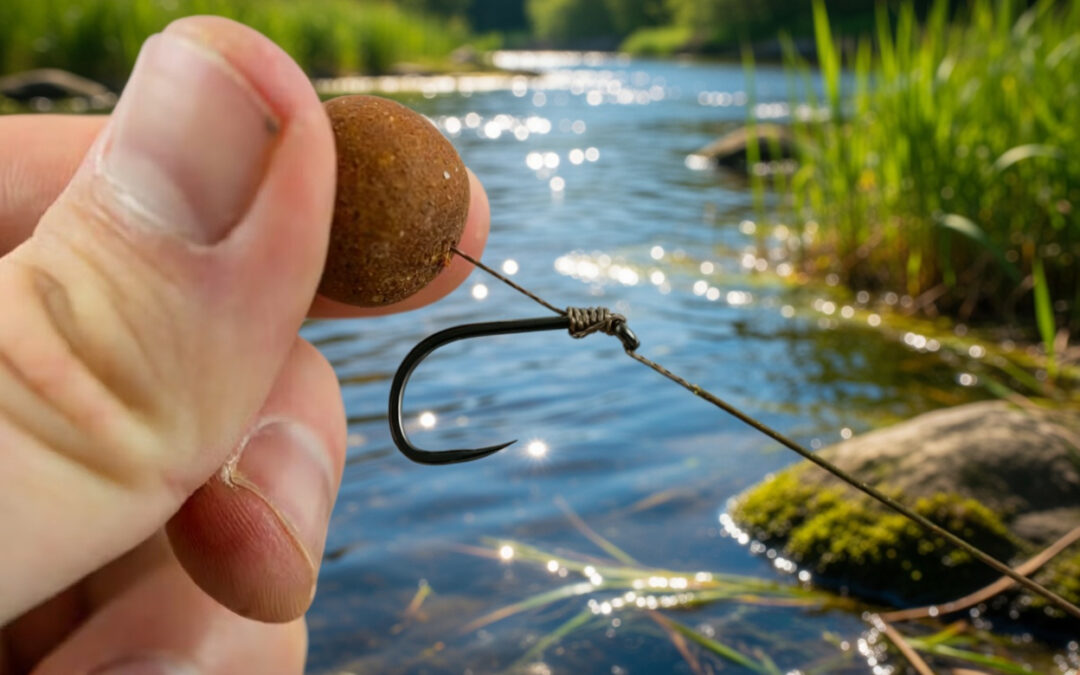
The Ronnie Rig — also called the 360° rig — has become one of the most widely-fished carp rigs on UK waters. Its rotating hook mechanism makes it mechanically superior to almost any other pop-up or wafter presentation, and it’s straightforward to tie once you have the right components.
What Is the Ronnie Rig?
The Ronnie Rig uses a spinner bead (Ronnie bead) — a small component from Fox, Korda, or Nash — that sits between the hook and the hooklink swivel. The hook attaches to the spinner bead via shrink tube at the bend and hangs freely. Because it spins completely freely, no matter which angle a carp mouths the hookbait, the hook always rotates to find the bottom lip.
It is designed exclusively for pop-up or wafter hookbaits presented 1–2cm off the lakebed. Tungsten putty on the hooklink critically balances the pop-up so it hovers just above the bottom — light to suck in, mechanically deadly.
When to Use the Ronnie Rig
The Ronnie Rig excels on:
- Clean gravel bars — hook rotation works freely with nothing to snag
- Firm sand and clay bottoms
- Clear-water spots in winter and spring — even half-hearted mouthing results in hook hold
- Any clean bottom where you’ve confirmed the lakebed is free from weed or silt
Avoid it in thick weed (use a Chod Rig) or deep silt (where the whole rig sinks and the hookbait gets masked — again, the Chod handles this better).
What You Need
- Curved-shank hook — size 4 or 6. Fox Armapoint Longshank Curve, Korda Spinner Hook, Nash Fang Spinner
- Spinner bead / Ronnie swivel — Fox Ronnie Rig Swivel or Korda Spinner Swivel Bead. Non-negotiable
- Shrink tube — small diameter, to form the hook kicker at the bend
- Fluorocarbon hooklink — 15–20lb, approximately 20–25cm
- Pop-up or wafter hookbait — 12–15mm is a good all-round size
- Tungsten or rig putty — for critically balancing the hookbait
How to Tie the Ronnie Rig — Step by Step
- Thread shrink tube onto the hook from the eye end, slide to just above the bend
- Attach hook to the spinner bead — thread the bead’s pin through the hook eye from the back of the hook; rotate until the hook hangs freely and spins 360°
- Shrink the tube — dip briefly in boiling water to shrink it tight. It should form a kicker angling the hook point away from the hooklink at roughly 45°
- Tie the hooklink — cut 25cm of fluorocarbon, form a small loop at one end (the hair), thread the other end through the spinner bead’s swivel eye and secure with a Palomar knot
- Add a swivel at the top — tie a small swivel onto the hooklink top with a figure-of-eight loop knot to clip to your lead system
- Attach the hookbait — thread hair loop through the hookbait, retain with a boilie stop. Hair length: 2–3cm from hook eye to bait
- Balance with putty — small amount of tungsten putty near the spinner bead. The hookbait should hover 1–2cm off the lakebed, barely held down
Always test in the margins before casting. If the bait floats up, add a fraction more putty. If it sinks, reduce.
Lead Setup
The Ronnie Rig works best on a lead clip or inline lead. An inline lead delivers the most direct bolt-rig contact. For distances beyond 60 yards, a flat pear lead improves aerodynamics and accuracy. See our guide to carp fishing leads for full lead selection advice.
Tips for Getting More From the Ronnie Rig
- Check hook rotation before every cast — grit in the spinner bead locks the mechanism. Clean it each session
- Sharp hooks only — check the point with a fingernail. A good hook catches; a blunt one slides
- Keep the hair short — 2–3cm maximum from eye to bait. A longer hair reduces hooking efficiency
- Use wafters on pressured fish — a critically balanced wafter looks more natural than a full pop-up to wary fish
- Adjust putty to water temperature — putty softens in warm water. In summer use less; in winter warm it in your hands before applying
Common Mistakes
Spinner bead too stiff: If the hook doesn’t rotate freely, you have a standard pop-up rig, not a Ronnie. Check the mechanism before every cast.
Using a bottom bait: The Ronnie is pop-up and wafter only. For bottom baits use the Blowback Rig or Combi Rig.
Too much putty: Pins the hookbait hard on the bottom, negating the rotation advantage entirely.
Wrong lakebed: In weed or deep silt, switch to the Chod Rig.
For a complete breakdown of all named carp rigs and when each one applies, see our complete guide to carp fishing rigs. To understand how hooklink length affects your presentation, see our carp rig length guide.
Last Updated on September 9, 2026 by Shane Stanford
Shane Stanford has fished for carp for over twenty years, in the UK and in France, and currently fishes a private syndicate water in West Sussex. He writes Fishing Again to put the things he learned the hard way into plain language: location and watercraft first, then bait, rigs and gear. He is straight about which kit he has actually fished and which he has assessed on specification, and says so on the page.


