
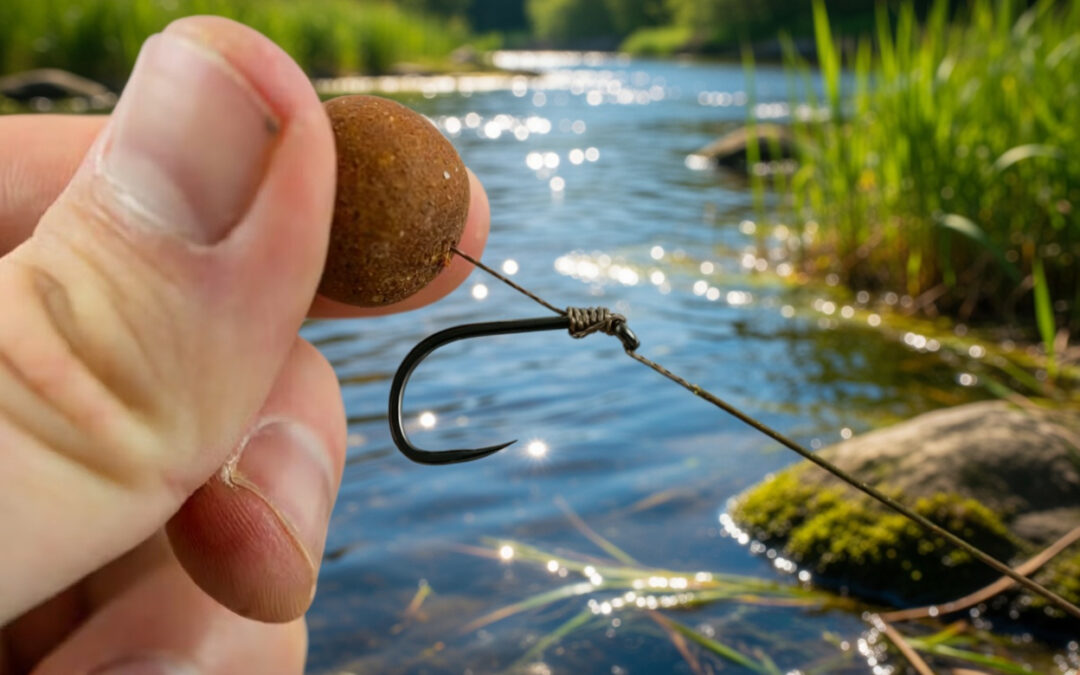
If you asked experienced UK carp anglers to name the single most effective pop-up rig ever designed, a significant proportion would say the Hinged Stiff Link. It’s more complex to tie than a Ronnie or Chod Rig, and it demands more preparation — but when it’s tied correctly and matched to the right lakebed, it produces fish that nothing else touches.
What Is the Hinged Stiff Link Rig?
The Hinged Stiff Link consists of two sections joined at a “hinge” point:
- A long stiff fluorocarbon boom (typically 8–15cm) attached to the lead swivel at one end and the hinge swivel at the other. This boom keeps the pop-up well away from the lead
- A short supple hooklink section (4–6cm) from the hinge swivel to the hook. The suppleness allows the hook to rotate aggressively on the take
The hinge is a small swivel linking the two sections. Because the boom is stiff and the hooklink supple, the rig self-rights instantly on the lakebed — the heavy boom pins down while the pop-up and supple hooklink hover above it in a natural, critically balanced position. The pop-up can never be masked by the lead because the boom holds it well clear.
Why It’s So Effective
Most pop-up rigs position the hookbait 2–5cm from the lead swivel. On a silty or weedy bottom, the lead swivel area can still collect debris and mask the rig. The Hinged Stiff Link boom extends the hookbait 8–15cm away from all of this — it’s fishing in genuinely clean water above the lakebed surface, not just trying to.
The supple hooklink section provides excellent hook rotation. When a carp mouths the pop-up and blows back, the hinge allows the hooklink to pivot freely at the junction — the hook sweeps across the bottom lip at a very efficient angle. Field and clinical testing consistently shows the Hinged Stiff Link converting more half-hearted enquiries to hooked fish than any other pop-up rig.
When to Use the Hinged Stiff Link
- Any clean bottom where pop-up presentation is appropriate — gravel bars, firm clay, sand
- Moderate silt — the boom keeps the pop-up above debris. For very deep silt, the Chod Rig is more reliable
- Big, wary fish — the combination of wide hookbait presentation and free-moving hinge makes it very difficult for a careful fish to reject
- Syndicate and specimen waters where fish are under low pressure but extremely experienced and wary
What You Need
- Stiff fluorocarbon — 20–25lb for the boom. Korda Mouth Trap, Drennan Carp/Chod Fluorocarbon, or similar. Must hold its shape without curling
- Supple braid — 15–20lb for the short hooklink section. Korda IQ2, Drennan Supplex, or stripped coated braid
- Small hinge swivel — a size 8 or 10 micro swivel to join boom and hooklink
- Curved-shank pop-up hook — size 4–6
- Pop-up hookbait and tungsten putty — for critical balancing
- Shrink tube or kicker — to set the hook angle at approximately 45° from the hooklink
How to Tie the Hinged Stiff Link — Step by Step
- Tie the hook section first — cut 8cm of supple braid. Tie a knotless knot at your chosen curved-shank hook, setting a hair of 2–3cm. Thread a piece of shrink tube over the hook before tying, position it at the bend, and shrink it to create a 45° kick
- Add the hinge swivel — tie a figure-of-eight loop at the top of the short hooklink section. Clip a size 8–10 swivel onto this loop
- Tie the boom — cut 10–12cm of stiff fluorocarbon. Tie a loop at one end and clip it to the hinge swivel. Tie a Palomar or loop knot at the other end to create the attachment point for your lead swivel
- Check self-righting — lay the assembled rig on a hard surface and let it settle. The boom should lie flat; the hook and short hooklink should spring upward, the pop-up wanting to lift. If it doesn’t self-right, check the boom stiffness and hinge swivel freedom
- Attach the pop-up — thread the hair through the pop-up and retain with a boilie stop. Apply a pinch of tungsten putty to the junction of boom and hinge swivel to critically balance the hookbait (it should just barely be held down)
Tips for Fishing It More Effectively
- Measure the pop-up height — use a small float stopper or putty to test in the margins. The pop-up should sit 10–15mm off the lakebed, not 3cm or more
- Boom length to lakebed type — firm gravel: 8–10cm boom. Moderate silt: 12–15cm boom so the pop-up clears more debris
- Use a quality hinge swivel — a cheap swivel that binds under the weight of the boom defeats the purpose of the hinge. Use a quality micro swivel that rotates freely under load
The Hinged Stiff Link requires more preparation time than rigs like the Multi Rig or Ronnie Rig, but many anglers tie a batch of 6–10 at home and store them in a rig wallet ready for the bank. Return to our complete carp rig guide for a full overview of every named rig.
Last Updated on September 9, 2026 by Shane Stanford
Shane Stanford has fished for carp for over twenty years, in the UK and in France, and currently fishes a private syndicate water in West Sussex. He writes Fishing Again to put the things he learned the hard way into plain language: location and watercraft first, then bait, rigs and gear. He is straight about which kit he has actually fished and which he has assessed on specification, and says so on the page.


