
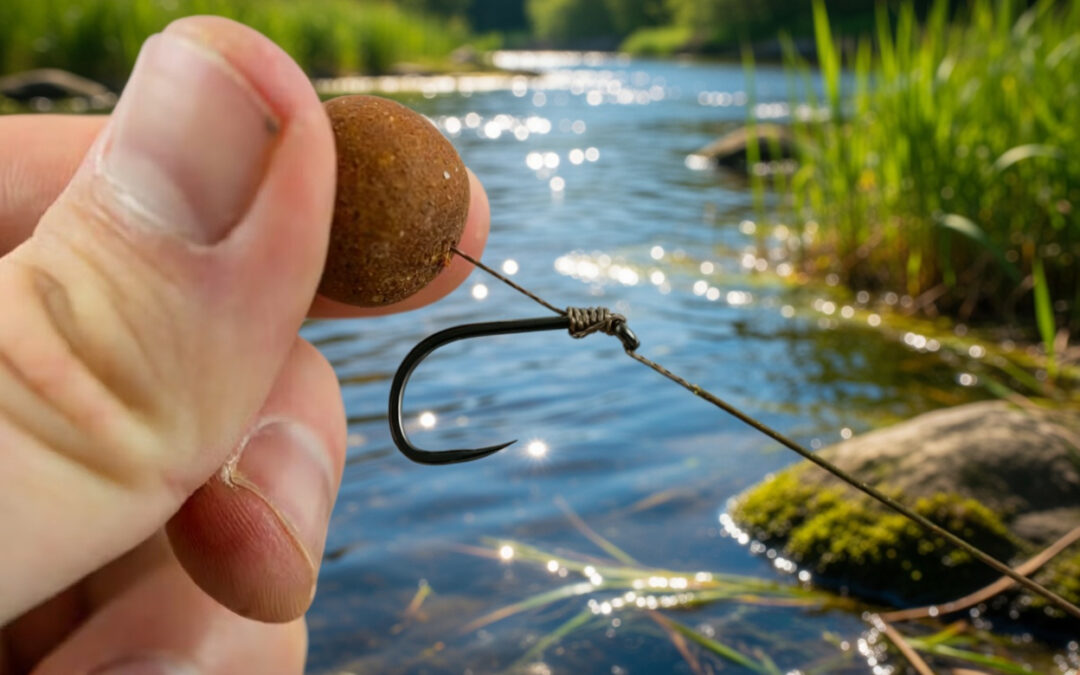
If you’re fishing a standard hair rig and losing fish, getting short takes, or watching carp mouth your hookbait in the margins without getting hooked, the Blowback Rig is likely the answer. It’s a simple modification to the basic hair rig that completely changes how the hook behaves when a carp tries to eject the bait — and it’s one of the most consistently effective rigs on UK carp waters.
What Is the Blowback Rig?
On a standard hair rig, the hair is fixed — it exits the hook eye and the hookbait hangs on it at a set distance. The Blowback Rig changes this: the hair is threaded through the hook eye so that it can slide freely. A small boilie stop or shrink ring at the eye prevents it from sliding completely off, but within that limit the hair moves.
When a carp sucks in the hookbait and attempts to blow it back out — which is exactly what pressured, cautious carp do — the hookbait slides back along the hair toward the hook. As it does, the hook rotates under the lip of the fish and takes hold before the fish can eject the rig. The “blowback” action becomes the hooking mechanism itself.
Why Is This Better Than a Standard Hair Rig?
On a fixed-hair setup, when a carp blows the bait out, the bait travels backward on a fixed axis. The hook has less rotation freedom. A carp that has seen hundreds of standard hair rigs knows instinctively how to angle the blow to eject both bait and hook simultaneously.
On the Blowback Rig, the moving hair creates a different hook rotation dynamic. The hook finds the bottom lip at a more aggressive, harder-to-counter angle. On heavily pressured day-ticket waters where carp have learned to eject standard setups, this difference in mechanics translates directly to more landed fish.
When to Use the Blowback Rig
- Pressured day-ticket and commercial waters — anywhere carp have been fished for regularly and are rig-savvy
- Bottom bait fishing on clean lakebeds — gravel, sand, firm clay
- Wafter presentations — a critically balanced wafter on a Blowback hooklink is one of the most effective setups you can fish
- Anywhere you’re getting liners or short takes without hooked fish
What You Need
- Coated braid hooklink material — 15–20lb. The stiff coated section prevents tangles; the stripped end near the hook provides the required suppleness for the hook to rotate
- Wide-gape hook — size 4–8 depending on hookbait size. Fox Edges Armapoint, Korda Wide Gape, Nash Fang, or similar. A wide-gape pattern allows the rotation under the lip more freely
- Micro ring or small rubber O-ring — threaded onto the hook eye to retain the hair in position. The hair threads through the eye, then through this ring, and the ring limits the slide distance
- Bottom bait or wafter hookbait — 12–18mm standard boilie or wafter
How to Tie the Blowback Rig — Step by Step
- Strip the coating — strip 4–6cm of coating from one end of your coated braid. This stripped section sits at the hook end
- Thread a micro ring onto the hook — slide a small rubber ring or micro rig ring over the hook point and position it at the eye. This ring retains the hair
- Form the hair — cut a short length of the stripped braid (or use lightweight mono) approximately 4–6cm long. Thread one end through the hook eye, then back through the micro ring at the eye. The hair hangs from this loop and can slide freely within the limits of the ring
- Tie a knotless knot — using the main hooklink material, wrap down the shank and pass back through the eye as normal. The key difference is that the hair is not incorporated into the knotless knot — it’s already fixed by the ring and moves independently
- Check hair movement — the hair should slide freely along the hook shank when you push the hookbait upward (simulating the blowback action). It should travel 8–12mm and be stopped by the ring at the eye
- Add the hookbait — thread the hair through your boilie or wafter and retain with a boilie stop. Hair length: 2.5–3.5cm from the eye to the bait
- Tie a swivel at the top of the hooklink with a figure-of-eight loop knot
Critical Hair Slide Distance
The blowback distance — how far the hair can slide — is crucial. Too short (under 6mm) and the hook doesn’t get enough rotation. Too long (over 15mm) and the hair slides too far before the hook rotates, allowing the fish to eject it anyway. Aim for 8–12mm of free slide when you push the hookbait up toward the eye with your finger.
Pairing With the Right Lead Setup
The Blowback Rig is a bottom-bait presentation that works best on a semi-fixed bolt rig — an inline lead or lead clip with a tight tail rubber. The bolt-rig principle means the fish hooks itself against the weight of the lead when it bolts away. A running setup reduces this bolt effect and is not ideal for this rig. See our lead guide for full setup advice.
Blowback Rig Variations
The Stripped Blowback: Replace the coated braid hooklink entirely with a length of stripped braid. More supple, suited to close-range fishing where anti-tangle properties are less critical.
Wafter Blowback: Replace the standard bottom bait with a critically balanced wafter. The reduced weight of the wafter makes it easier to suck in, and the blowback mechanics still work perfectly.
Snowman Blowback: Combine a standard boilie with a small pop-up on the hair — the classic Snowman Rig presentation — on a Blowback hooklink. One of the most consistent setups for clean, hard bottoms.
Common Mistakes
Hair incorporated into the knotless knot: This fixes the hair and removes the blowback function entirely. The hair must be attached via the ring at the eye and must slide freely.
Ring too large: A large ring allows the hair to travel too far. Use a micro ring (2–3mm diameter) so the slide distance stays in the 8–12mm sweet spot.
Using a pop-up: The Blowback Rig is a bottom-bait rig. For pop-up presentations, use the Ronnie Rig or Multi Rig.
Return to our complete guide to named carp rigs for an overview of every major rig in UK carp fishing. For more on how terminal tackle works together under the rig, see our carp rigs guide for beginners.
Last Updated on September 9, 2026 by Shane Stanford
Shane Stanford has fished for carp for over twenty years, in the UK and in France, and currently fishes a private syndicate water in West Sussex. He writes Fishing Again to put the things he learned the hard way into plain language: location and watercraft first, then bait, rigs and gear. He is straight about which kit he has actually fished and which he has assessed on specification, and says so on the page.


