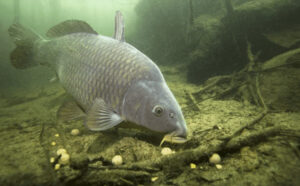

The Chod Rig solves one of carp fishing’s most frustrating problems: how do you present a hookbait cleanly when the lakebed beneath your lead is silty, weedy, or covered in debris? The Chod presents your hookbait cleanly on top of all of it, every single time.
What Is the Chod Rig?
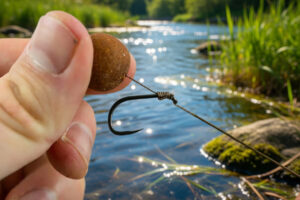
The Chod Rig consists of a short (4–5cm), very stiff fluorocarbon hooklink tied to a curved-shank hook, with a pop-up hookbait. The hooklink assembly sits on the mainline between two rubber beads above the lead. When you cast, the lead sinks down through any silt or weed to the lakebed. The short, stiff Chod hooklink then pops up and presents the hookbait cleanly above whatever the lead sank into.
This is the key insight: the Chod Rig ignores the lakebed. It doesn’t matter if there’s 40cm of silt or a metre of weed. The lead goes through it, and the rig pops up above it. As long as there’s water above the lakebed, the Chod presents perfectly.
When to Use the Chod Rig
- Silty lake beds — where a standard rig sinks and is completely masked. See our guide to fishing over silt
- Weed beds — rig pops up above the weed canopy. Our weed fishing guide covers broader weed tactics
- Mixed or unknown bottoms — when you genuinely can’t identify lakebed composition
- Large, open waters — impossible to find every clean spot before casting
- When fish are showing and you need a rig in fast
Less effective on very clean hard gravel — a Ronnie Rig or standard bottom bait will often outperform it there, as a standing pop-up on bare clean gravel can look suspicious to pressured fish.
What You Need
- Stiff Chod fluorocarbon — 20–25lb. Korda Chod Filament, Drennan Carp Chod, or Gardner Covert Chod. Standard fluorocarbon isn’t stiff enough
- Curved-shank hook — size 4–6. Korda Chod Hook, Nash Fang Gaper, or ESP Chod Silt
- Small ring swivel — to form the connection loop at the top of the hooklink
- Rubber Chod beads — Korda Heli-Safe, Fox Chod Rig System, or similar. These sit on the mainline above the lead
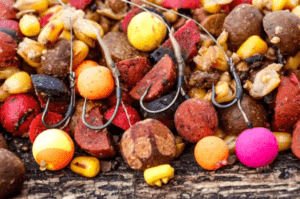
- Pop-up hookbait only — the Chod Rig only works with buoyant hookbaits
How to Tie a Chod Rig — Step by Step
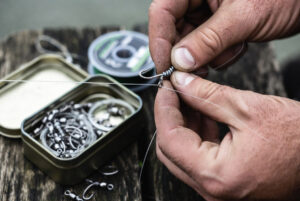
- Cut 8–10cm of stiff Chod fluorocarbon — slightly longer than needed, trim after shaping
- Form the top loop — tie a small overhand loop, or thread a ring swivel and secure with an overhand knot. This clips between the beads on your mainline
- Tie a knotless knot at the hook — before tightening, set the angle so the hook kicks outward at approximately 45°. This kick is critical: it makes the Chod self-right and strip out of a carp’s mouth on the take
- Set the hair — 1.5–2cm from the back of the hook bend. Thread pop-up, retain with a boilie stop
- Shape the hooklink — hold over steam or dip in hot water to set a gentle banana curve. The curve improves hooking efficiency significantly
- Trim to 4–5cm from ring swivel to hook bend
- Assemble beads on mainline above the lead: bottom bead, then Chod hooklink clips on, then top bead. Allow 8–12cm travel between beads
Lead System: Use a Helicopter Setup
The helicopter lead arrangement was designed alongside the Chod. The lead hits the lakebed first and sinks in; the rig then helicopters down and settles cleanly above it. This is covered fully in our helicopter rig guide. Always use a safety clip system that allows lead ejection on the take for safe fish playing.
Tips for Fishing the Chod More Effectively
- Adjust bead travel to silt depth — in shallow silt (under 10cm), 6–8cm travel is enough. In deeper silt (20cm+), allow 12–15cm so the rig pops fully clear
- Use 15–18mm pop-ups in deep silt — more lift. Use 10–12mm on clear-water, pressured situations
- Replace hooks regularly — stiff hooklinks put more mechanical stress on hooks during the take
- Check the angle before every session — if the kicker angle has relaxed, the rig won’t self-right correctly. Re-shrink or retie
Common Mistakes
Using standard fluorocarbon: Too soft. You need dedicated Chod fluorocarbon with high memory. Standard lines produce a floppy hooklink that can’t self-right.
Hooklink too long: Keep strictly to 4–5cm. A longer hooklink loses the self-righting mechanics. For a longer stiff pop-up presentation, use the Hinged Stiff Link instead.
Wrong hook angle: If the hook doesn’t kick outward at 45° from the hooklink, the rig won’t rotate on the take. Retie until the angle is right.
For all named carp rigs in one place, see our complete guide to carp fishing rigs. For broader bottom-reading skills, our watercraft guide covers everything you need to identify the right lakebed before you even tie a rig.
Last Updated on June 11, 2026 by Shane
I have made a lot of mistakes during my fishing sessions and don't want you to make the same mistakes. I've learned the hard way over 20 years of fishing most weekends, testing, tweaking, and testing again and now want to help you excel with your carp fishing.
If you need any help, you can reach me at Fishing Again's Facebook page