The most effective carp anglers are students of fish behaviour before they’re students of tackle. Understanding how carp actually feed, why they move, what makes them cautious, and what triggers a feeding response is the foundation of consistent catches regardless of which rig or bait you use.
How Carp Feed
The Feeding Mechanism
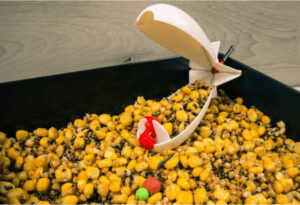
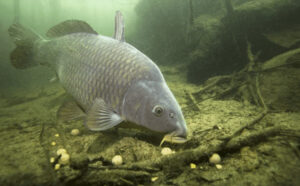
Carp are bottom-rooting fish by nature. They create suction by expanding the mouth cavity — a powerful, rapid inflation that draws in water and food simultaneously. This water is then expelled through the gill rakers, which filter out food items and pass them to the pharyngeal teeth (throat teeth) for crushing. This feeding mechanism is why particle baits like hemp work so well — the carp can’t distinguish individual hemp seeds from surrounding debris, so it sucks up everything in the area including the hookbait.
The same mechanism is why rig design matters so much. A hookbait that can be sucked in with minimal effort and then expelled easily will be ejected by cautious carp. A rig that creates a mechanical difficulty during ejection — like the Blowback Rig or Ronnie Rig — is harder to eject cleanly, increasing the chance of a hook hold.
The Bolt Reflex
When a carp feels resistance — from the lead weight on a bolt rig setup — it instinctively accelerates away from the threat. This bolt reflex drives the hook home against the fixed lead weight. The entire bolt rig concept (semi-fixed or fixed lead, non-ejectable) is designed to exploit this reflex. See our lead and weight guide for how lead setup affects the bolt effect.
How Water Temperature Drives Carp Behaviour
Carp are ectothermic (cold-blooded). Every aspect of their physiology — digestion, metabolism, immune function, activity level — is dictated by water temperature. This is the single most important variable in carp fishing.
- Below 8°C: Metabolism is extremely slow. Carp barely feed, move minimally, and congregate in deep, stable water. Any food they do take is slowly digested. Small, high-attract, low-volume baits are needed. Winter carp fishing requires significant patience — see our winter carp guide
- 8–12°C: The transition zone. Carp begin feeding again, but cautiously and in short windows. Late morning and afternoon are most productive as surface water warms. See our spring carp fishing guide
- 12–18°C: Active, sustained feeding. Carp will eat almost anything they recognise as food in reasonable quantities. Standard approaches work well
- 18–24°C: Peak summer feeding, particularly dawn and dusk. Midday in very warm weather can see fish shut off completely — they ride in the upper water column seeking oxygenated water. Zig Rigs excel in this window
- Above 24°C: Carp become stressed in warm, low-oxygen water. They may stop feeding entirely. At these temperatures, always return fish immediately and minimise handling time. See our carp care guide
For the complete picture on water temperature and carp, our dedicated water temperature guide covers every temperature range in detail.
How Carp Use the Lake
Patrol Routes
On any established water, carp follow regular patrol routes — circuits of the lake that they travel at predictable times of day. These routes connect the features they use: feeding areas, resting areas, spawning zones, and sanctuary areas. Once you’ve identified a patrol route through observation over multiple sessions, fishing along it consistently will produce results regardless of conditions.
Safe Areas and Sanctuaries
Carp learn quickly where the angling pressure is highest and actively avoid those areas during daylight. On a busy day-ticket water, the swims that are always occupied are rarely where the fish want to be. The far margins, snaggy areas, weedbeds, and islands that are hard to reach are the fish’s sanctuary. Accessing these areas — by stalking, by fishing awkward angles, or by simply being present when others aren’t (at first light or at night) — often produces the best fish. Our stalking guide covers accessing difficult sanctuaries on foot.
Shoal Behaviour and Competition Feeding
Carp are semi-social fish. They form loose shoals and when one fish in a group starts feeding confidently, the competitive pressure of the group accelerates feeding across all fish in the area. This is why pre-baiting works — once one or two fish establish confidence on a bait area, they attract others. A pre-baiting campaign exploits shoal feeding behaviour to create a predictable, high-competition feeding zone.
How Carp Learn to Avoid Rigs
Modern carp on pressured UK waters are remarkably good at identifying rigs. They can detect subtle differences in hookbait behaviour — the way a critically balanced hookbait moves differently from a heavy, fixed one — and adjust their approach to eject suspicious baits before the hook takes hold. On hard day-ticket waters, fish may have been hooked and returned dozens of times. They do develop genuine rig-wariness through experience.
The most effective response is a combination of: presentation quality (a rig that lies flat and looks natural), hook sharpness, and regular rig change. A rig that has been in the water for 6+ hours, collected debris, and been investigated without a take should be changed. Fishing with confidence — meaning a rig you genuinely believe is working well — produces better results than fishing half-heartedly with a rig you suspect is compromised. Our complete rig guide covers how to choose a presentation that minimises rig detection.
Last Updated on June 11, 2026 by Shane
I have made a lot of mistakes during my fishing sessions and don't want you to make the same mistakes. I've learned the hard way over 20 years of fishing most weekends, testing, tweaking, and testing again and now want to help you excel with your carp fishing.
If you need any help, you can reach me at Fishing Again's Facebook page