
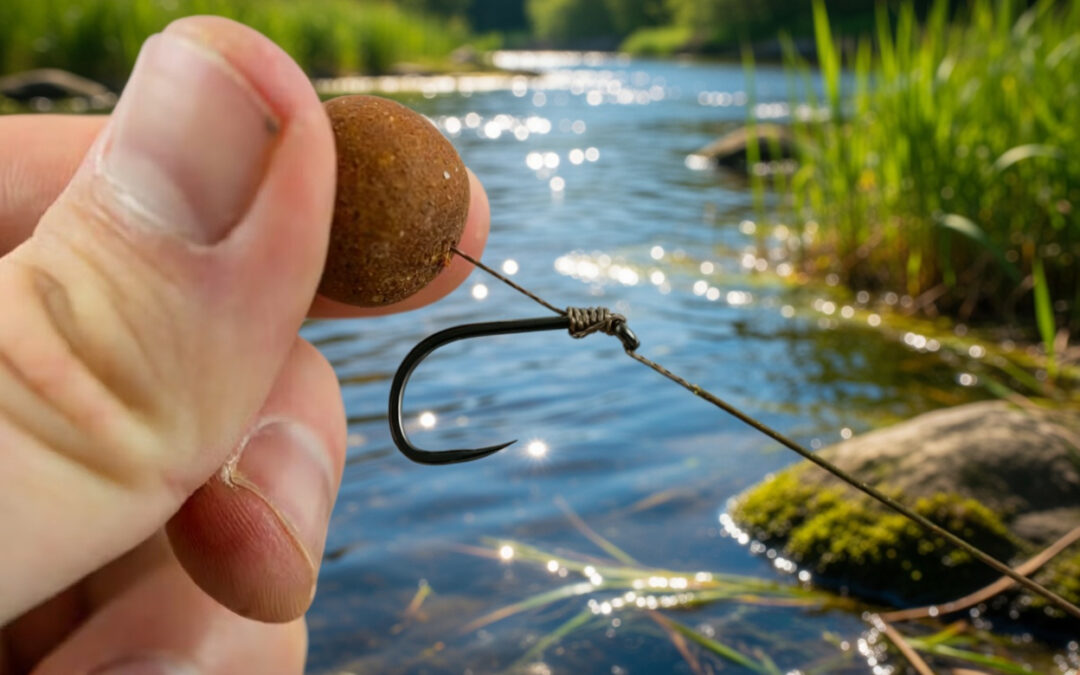
The KD Rig has built a substantial reputation as a big-fish, pressured-water rig — and that reputation is deserved. While it looks similar to a standard knotless knot setup from a distance, the angle at which the hair exits the hook is what makes it work so differently. This guide explains the mechanics, how to tie it correctly, and when to fish it.
What Is the KD Rig?
The KD Rig — named after Kent angler Kevin Nash’s work in developing what is sometimes called the “Kevin’s Dodge” — uses a curve-shank or straight-point hook where the knotless knot is tied so the hair exits the hook at a very aggressive downward angle near the bend, rather than straight out from the eye.
The result: when a carp sucks in the hookbait and attempts to blow it back out — as all modern, pressured carp do instinctively — the angle of the hair causes the hook to rotate aggressively toward the bottom lip and take hold before the fish can eject it. A short section of stripped coated braid or stiff mono provides the exact amount of stiffness needed for the hook to move correctly.
When to Use the KD Rig
The KD Rig performs best as a bottom-bait presentation on:
- Pressured commercial and day-ticket waters — where fish have learned to eject rigs efficiently. The aggressive hook angle is harder to beat than a standard knotless knot setup
- Clean gravel and hard clay — the rig needs a firm bottom to function correctly. The hook sweeps along the bottom and turns under the lip
- Big fish at range — the KD’s mechanics work at any distance where you can achieve a clean, tight lead
- When standard hair rigs are producing short takes or missed runs — a switch to the KD often converts those to landed fish
What You Need
- Curve-shank hook — size 4–6. The Korda Wide Gape X, Fox Edges Armapoint Straight Point, or Nash Fang X are ideal. The curve of the shank is what allows the aggressive rotation
- Coated braid hooklink — 15–20lb. Strip the coating 3–4cm from the hook end to create the supple section. Total hooklink length 15–20cm
- Small hookbait — 10–15mm boilie or paste. The KD works best with a modest-sized bait; large hookbaits reduce the rotation speed
How to Tie the KD Rig — Step by Step
- Strip the coating — strip 3–4cm of coating from one end of your coated braid hooklink material
- Thread the stripped end through the hook eye — from the front (point side) through to the back
- Fold back a short hair — approximately 2cm from the hook eye, fold the stripped section back to create the hair. The total hair length from eye to bait should be around 2–3cm
- Begin the knotless knot — hold the hair at the correct length and begin wrapping the main hooklink material down the shank toward the bend. This is the same as a standard knotless knot
- Critical angle: wrap to the bend, not the eye — make 6–8 tight wraps and end the knot near the bend of the hook, not mid-shank. This is what creates the downward exit angle on the hair
- Pass the line back through the eye and pull tight. Wet the knot before final tightening
- Check the angle — the hair should exit the hook pointing distinctly downward, roughly 45° below the horizontal. If it exits upward or straight, the knot is positioned too high on the shank — retie
- Add swivel at top — secure a small swivel to the coated end with a figure-of-eight loop knot
Hookbait Positioning
The hookbait should sit 2–3cm below the hook bend on the hair. For the KD Rig, a bottom bait or wafter is correct — not a pop-up. A pop-up on this rig lifts the hook off the bottom and reduces the sweeping rotation that makes the KD effective. If you want a pop-up rig on clean gravel, the Ronnie Rig is the better choice.
Critically Balancing the KD
One of the most effective ways to fish the KD Rig is with a critically balanced hookbait — a bottom bait with a small piece of cork or foam glued inside, or a wafter — so the bait is near-neutral in the water. This means less resistance for the fish when it sucks the bait in and maximises the hook’s rotation speed. Our guide to the Snowman Rig covers critical balancing in more detail.
Common Mistakes
Hair exits upward: The knot is positioned too high. The defining feature of the KD is the downward exit angle. Re-wrap the knotless knot further down the shank toward the bend.
Hook too large: A size 2 or 1 on a KD slows the rotation significantly. Stick to size 4–6 with a proportionate hookbait.
Coated braid fully stripped: The stiffness of the coated section is what prevents the hooklink tangling during the cast. Strip only the 3–4cm near the hook; leave the rest coated.
To see how the KD Rig fits into the full range of named carp rigs, return to our complete carp rig guide. For information on all aspects of terminal tackle that support your rig, see our guide to rig swivels and lead selection guide.
Last Updated on September 10, 2026 by Shane Stanford
Shane Stanford has fished for carp for over twenty years, in the UK and in France, and currently fishes a private syndicate water in West Sussex. He writes Fishing Again to put the things he learned the hard way into plain language: location and watercraft first, then bait, rigs and gear. He is straight about which kit he has actually fished and which he has assessed on specification, and says so on the page.


