
If you have already chosen your first carp fishing rod, the next big decision is picking a reel to pair with it. The reel is just as important as the rod in your carp fishing setup, and getting the right one will make your time on the bank far more enjoyable and productive. Getting the wrong one, however, can lead to tangles, lost fish, and a whole lot of frustration.
In this guide, I am going to explain the different types of carp fishing reels available, what the key features are that you need to understand, and how to choose the right reel for your needs and budget. Whether you are brand new to carp fishing or looking to upgrade from a basic setup, this article will give you the knowledge to make a confident decision.
Why You Need a Proper Carp Fishing Reel
Carp are powerful fish that can make long, powerful runs when hooked. A standard coarse fishing reel simply is not built to handle this kind of pressure. Carp fishing reels are designed with larger spools to hold more line, stronger drag systems to control running fish, and robust internal gearing to withstand the punishment that carp dish out season after season.
Using an undersized or inadequate reel for carp fishing is a recipe for disaster. The clutch may slip unevenly, causing the fish to gain too much line or, worse, causing a sudden jolt that rips the hook free. The line capacity may not be sufficient, especially if you are fishing at range or dealing with a fish that decides to go on a long run towards the far margin. And a cheap reel with poor internal gearing will develop play and wobble after just a few sessions, making it difficult to reel in smoothly.
Types of Carp Fishing Reels
Baitrunner Reels
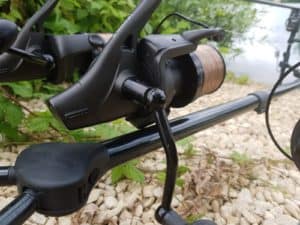
The baitrunner reel, originally developed by Shimano, is arguably the most popular type of carp fishing reel in the UK. The defining feature of a baitrunner reel is a secondary drag system that allows the spool to rotate freely when a fish picks up the bait and starts to move away. This is engaged by a lever at the rear of the reel and disengaged automatically when you turn the handle to strike.
The advantage of the baitrunner system is that it allows a carp to take line without feeling significant resistance, which reduces the risk of the fish dropping the bait before you can strike. Once you turn the handle, the baitrunner disengages and the main drag takes over, giving you full control to play the fish. This seamless transition from free spool to fighting drag is what makes baitrunner reels so popular among carp anglers.
For beginners, a baitrunner reel is an excellent choice because it simplifies bite detection and striking. You set the baitrunner tension so that a taking fish can pull line freely, and when your alarm sounds, you simply pick up the rod and wind the handle. There is no need to fumble with the bail arm or adjust the clutch in the heat of the moment.
Big Pit Reels
Big pit reels are larger, heavier reels designed primarily for long-range casting. They feature oversized spools with a wide diameter and a wide lip, which allows line to flow off the spool with minimal friction during the cast. This translates into significantly greater casting distance compared to a standard-sized reel.
Big pit reels also tend to have very smooth, powerful drag systems and fast line retrieval rates due to the larger spool diameter. This makes them excellent for situations where you are fishing at extreme range and need to reel in a lot of line quickly, or where you are playing a big fish that is a long way out.
The downside of big pit reels is their size and weight. They are noticeably heavier than standard carp reels, which can make your setup feel unbalanced, particularly if you are using a lighter rod. They are also more expensive on average, and for beginners fishing on smaller waters where long casting is unnecessary, they are overkill.
If you are planning to fish mainly on commercial fisheries and day-ticket lakes where distances are modest, a standard-sized baitrunner reel will serve you far better than a big pit. Save the big pit for when you start fishing larger venues and genuinely need the extra range.
Standard Fixed Spool Reels
A standard fixed spool reel without a baitrunner facility can still be used for carp fishing, and many experienced anglers prefer them for certain situations. Without the baitrunner mechanism, you rely on the main drag system alone, loosening the clutch so that a taking fish can pull line and then tightening it when you pick up the rod.
The advantage of this approach is simplicity and reduced weight, as there is one fewer mechanism in the reel. Some anglers find that a good quality fixed spool reel with a smooth front drag gives them better control over playing fish than a baitrunner reel. However, for a beginner, the baitrunner system is more forgiving and easier to use, so I would recommend starting with a baitrunner reel unless you have a specific reason to go without.
Key Features to Understand
Drag System
The drag system, also called the clutch, is the mechanism that allows line to be pulled from the reel under a controlled amount of tension. A good drag system is smooth and consistent, applying even pressure throughout the range of adjustment. A poor drag system is jerky and inconsistent, which can lead to hook pulls and lost fish.
Carp reels come with either a front drag or a rear drag. Front drag systems are generally considered superior because the drag washers are larger and can therefore dissipate heat more effectively during a prolonged fight. Rear drag systems are more convenient to adjust on the fly because the adjustment knob is at the back of the reel, but they tend to be less smooth and less powerful than front drag systems.
For carp fishing, a front drag reel is the better choice in most situations. The drag should be set so that a running fish can take line without the hook being pulled, but not so loose that the fish can reach snags or other hazards before you can apply pressure.
Line Capacity
Carp fishing reels need to hold a sufficient amount of line to cover the distances you are fishing and to have enough reserve for a fish that makes a long run. Most carp anglers in the UK spool up with 12lb to 15lb monofilament line or a braid equivalent, and you need a reel that can hold at least 200 metres of your chosen line.
Check the line capacity specifications of any reel you are considering. Most reel manufacturers list the capacity for different line diameters, usually expressed as metres of a specific breaking strain. Make sure the reel can hold enough of the line you plan to use with some to spare for when a fish decides to empty your spool on a powerful run.
Gear Ratio and Retrieval Rate
The gear ratio tells you how many times the bail arm rotates around the spool for each turn of the handle. A higher gear ratio means faster line retrieval, which is useful for winding in slack line quickly or recovering line after a long cast. A lower gear ratio provides more cranking power, which can be helpful when playing a big fish at close range.
Most carp reels have a gear ratio somewhere between 4.5:1 and 5.5:1, which offers a good balance between speed and power. For beginners, the gear ratio is not something to worry about too much, as any reel in this range will perform well for general carp fishing.
Number of Ball Bearings
You will often see carp reels advertised with a specific number of ball bearings, and more is generally better as it means smoother operation. However, the quality of the bearings matters as much as the quantity. A reel with four high-quality stainless steel bearings will feel smoother than a reel with ten cheap bearings.
As a rough guide, look for a reel with at least four or five bearings for a smooth, reliable performance. Premium reels may have ten or more, but the diminishing returns at the higher end mean that you should not use the bearing count alone as a measure of quality.
How Much Should You Spend on a Carp Reel?
Just like with rods, you do not need to break the bank to get a capable carp fishing reel. The good news is that reel manufacturing has come a long way, and even budget reels today offer performance that would have been considered impressive just a decade ago.
At the entry level, between thirty and fifty pounds, you can find baitrunner reels from brands like NGT, TF Gear, and Daiwa’s budget ranges that will do the job for a beginner. These reels will not have the silky-smooth drag or the precision engineering of more expensive models, but they will function reliably and get you catching fish.
In the mid-range bracket of fifty to one hundred and twenty pounds, you start to see reels with significantly better build quality, smoother drags, and more durable internals. This is where the big-name brands like Shimano, Daiwa, Fox, and Nash offer some of their best value models. If you can stretch your budget into this range, you will get a reel that will last for many seasons and still be performing well long after a budget reel would have given up.
Above one hundred and twenty pounds, you are entering premium territory. Reels at this level are beautifully engineered and a joy to use, but the performance gains over a good mid-range reel are subtle. Unless you are fishing at a high level or simply want the best, your money is better spent on other aspects of your setup at this stage.
Matching Your Reel to Your Rod
A common mistake beginners make is buying a reel that is too large or too small for their rod. The ideal pairing creates a balanced setup that feels comfortable in your hands and performs well during casting and playing fish.
For a standard 12-foot carp rod with a 2.75lb test curve, a medium-sized baitrunner reel in the 6000 to 8000 class is the ideal match. This class of reel has enough line capacity for the distances you will be casting, enough drag power to handle good-sized fish, and is not so heavy that it makes your setup feel front-heavy or tiring to use over a long session.
If you are using a lighter rod, perhaps a 2.5lb test curve for float fishing or stalking, you can drop down to a 4000 to 6000 class reel. Conversely, if you are using a powerful 3.5lb long-range rod, you may want to step up to a 10000 class big pit reel to match the rod’s capabilities.
Loading Your Reel with Line
Once you have your reel, you need to spool it up with line. Getting the line level right is important for casting performance. The line should be wound on evenly and should come to within a couple of millimetres of the spool lip. Underfilling the spool will reduce your casting distance, while overfilling will cause tangles and wind knots.
When spooling up, keep tension on the line by trapping it against the rod with a damp cloth as you wind. This ensures the line is laid tightly and evenly on the spool, which prevents those infuriating tangles that seem to happen at the worst possible moment. If you are using monofilament line, soaking the spool in warm water for a few minutes after loading can help the line bed in and reduce memory coils.
Looking After Your Reel
A carp reel is a precision piece of equipment that needs regular maintenance to perform at its best. After every session, wipe down the reel body with a damp cloth to remove dirt, mud, and any grit that may have found its way into the mechanism. Pay particular attention to the line roller and bail arm, as these are the areas most prone to grit ingress.
Every few months, or more frequently if you fish in wet and muddy conditions, apply a small amount of reel oil to the bail arm mechanism, the line roller, and the handle shaft. This keeps everything moving smoothly and prevents corrosion. Avoid using too much oil, as excess lubricant can attract dirt and actually make things worse.
If your reel starts to feel rough or develops a grinding sensation, it may need a more thorough service. Many tackle shops offer reel servicing, or you can learn to do it yourself with the help of online tutorials. A well-maintained reel will last for years, so it is well worth investing a few minutes after each session to keep yours in top condition.
Final Thoughts
Choosing a carp fishing reel does not need to be complicated. For most beginners, a medium-sized baitrunner reel with a smooth front drag, in the sixty to one hundred pound price range, will be the perfect partner for your first carp rod. It will handle everything from small commercial carp to decent-sized fish on day-ticket waters, and it will serve you well for years as your skills develop.
As with all carp fishing tackle, the best reel is the one that gets you fishing. Do not get paralysed by choice or convinced that you need the most expensive option on the shelf. Pick a reel that fits your budget and your rod, spool it up with good quality line, and get yourself down to the lake. The fish do not care how much your reel cost, and neither should you at this stage of your journey.
Last Updated on March 11, 2026 by Shane
I have made a lot of mistakes during my fishing sessions and don't want you to make the same mistakes. I've learned the hard way over 20 years of fishing most weekends, testing, tweaking, and testing again and now want to help you excel with your carp fishing.
If you need any help, you can reach me at Fishing Again's Facebook page