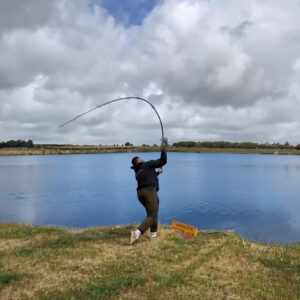

You have put in the time, chosen the right swim, presented your rig perfectly, and finally your alarm screams into life. A carp has picked up your bait. This is the moment every carp angler lives for, but it is also the moment where things can go wrong if you do not know what you are doing. Playing and landing a carp properly is a skill that combines technique, patience, and a genuine respect for the fish.
In this guide, I am going to take you through the entire process of hooking, playing, netting, and handling a carp. I will cover the common mistakes that lead to lost fish, the techniques that give you the best chance of landing every fish you hook, and the essential steps for handling and caring for your catch before returning it safely to the water.
Striking and Setting the Hook
When your alarm sounds and your bobbin lifts, the natural instinct is to rush to the rod and strike hard. This is one of the biggest mistakes beginners make. In most modern carp fishing setups, the weight of the lead and the sharpness of the hook do the work of setting the hook for you. When a carp picks up the bait and moves away, it feels the resistance of the lead and bolts, which drives the hook point home. By the time your alarm is screaming, the fish is almost certainly already hooked.
What you need to do is pick up the rod smoothly, engage the reel by turning the handle to disengage the baitrunner, and feel for the fish. You should feel the weight and movement of the carp on the other end. There is no need for a violent strike. Simply lift the rod to a semi-upright position and let the fish take line against the clutch if it wants to run.
The exception to this is if you are fishing with slack lines or at extreme range where there is a lot of line bow. In these situations, you may need to wind down rapidly to take up the slack before you connect with the fish. But even then, a controlled winding motion is far better than a savage strike, which can pull the hook or snap the hooklink.
Playing the Fish
The First Run
The first run of a hooked carp is often the most powerful. The fish will feel the hook and bolt, sometimes with terrifying speed and power. Your job during this initial run is to maintain steady pressure on the fish while allowing it to take line against the clutch. Do not try to stop the fish dead, as this will put enormous strain on your hooklink, hook hold, and line, and something will give.
Keep the rod at roughly a forty-five-degree angle to the water. This position gives the rod blank maximum shock-absorbing ability, cushioning the lunges and surges of the fish. If you hold the rod too high, you lose leverage and the tip section takes all the strain. If you hold it too low, the rod cannot flex properly and you are relying on the line and clutch alone to absorb the fish’s power.
Controlling the Fight
Once the initial run subsides, you need to start gaining line and working the fish towards you. This is where the classic pumping technique comes into play. Lift the rod steadily upwards to pull the fish towards you, then lower the rod while reeling in the slack. Repeat this process, and with each pump you will bring the fish a few feet closer.
The key is to maintain constant tension on the line throughout the fight. Slack line is the enemy because it allows the hook to work loose, gives the fish the opportunity to change direction without you knowing, and can result in the line catching on underwater obstacles. If the fish runs again during the fight, let it take line against the clutch, but always keep the rod bent and the line tight.
Dealing with Snags
Snags are underwater obstacles such as fallen trees, weed beds, overhanging branches, and submerged structures that a hooked fish will try to reach. Carp are incredibly adept at using snags to shed the hook, and once a fish reaches a solid snag, your chances of landing it drop dramatically.
If you are fishing near known snags, you need to be on your rods and ready to react quickly to a bite. When a fish runs towards a snag, you need to apply firm side-strain to turn its head away from the danger. This means holding the rod low and to one side, rather than straight up, to pull the fish on a lateral angle. Side-strain is far more effective at turning a fish than vertical pressure because it pulls the fish off balance.
Sometimes, despite your best efforts, a fish will reach a snag. If this happens, do not keep pulling, as this may drive the hook deeper into the snag or break your line. Instead, slacken off completely and wait. Often, a fish that has reached a snag will eventually swim out of its own accord once it no longer feels pressure. When the line starts to move again, pick up the rod and resume playing the fish. This technique requires patience and nerves of steel, but it works more often than you might expect.
Playing Fish in Weed
Weed is another hazard that carp will use to their advantage. A carp that reaches a thick weed bed can become buried in the vegetation, making it feel like you are pulling against a dead weight. The temptation is to haul hard to drag the fish out, but this risks pulling the hook or snapping the line.
When a fish is weeded up, apply steady, constant pressure and try to keep the fish moving. Often, maintaining gentle tension will cause the fish to kick free and resume the fight. If the fish is solidly weeded, try changing the angle of pull by moving your rod to one side or the other, which can free the line from the weed and allow you to resume contact with the fish.
Netting the Fish
Preparing the Net
Your landing net should be set up and ready before you start fishing. There is nothing worse than hooking a fish and then having to scramble around assembling your net while a carp thrashes around in the margins. Spread the net on the bankside with the handle within easy reach, or stand it in the margin with the mesh submerged and ready to scoop.
Use a landing net with a minimum spread of at least 42 inches for carp fishing. Anything smaller risks the fish bouncing off the rim during the netting process. Many carp anglers use 46-inch or 50-inch nets, which give you an even larger target to aim for.
The Netting Process
As the fish tires and you bring it into the margins, submerge your landing net in the water and hold it steady. Draw the fish over the net by keeping your rod high and guiding the fish towards you. When the fish is over the net, lift the net smoothly to enclose the fish. Do not chase the fish with the net, as this will spook it and cause it to bolt, potentially resulting in a hook pull at the very last moment.
The most common mistake when netting a fish is trying to net it too early. If the fish still has energy and starts thrashing when it sees the net, it can easily throw the hook or tangle the line around the net frame. Be patient and wait until the fish is lying on its side and clearly tired before you attempt to net it. A few extra minutes of playing time is far better than losing the fish at the net.
Once the fish is in the net, lower the rod and allow the line to go slack. Do not try to lift the fish out of the water by the line, as this puts enormous strain on the hook hold and can result in the fish slipping free. Rest the rod on the ground and then lift the net with the fish inside onto your unhooking mat.
Handling and Caring for the Fish
The Unhooking Mat
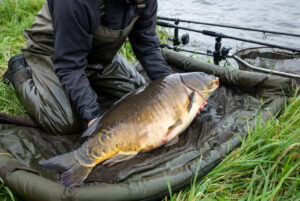
Every carp angler must carry an unhooking mat. This is a padded mat that protects the fish from the hard ground while you remove the hook, take photos, and weigh your catch. Carp are delicate creatures despite their size and power, and even a short drop onto bare ground can cause serious damage to their internal organs and scales.
Place your unhooking mat close to the water’s edge before you start fishing. Wet it with lake water so that it does not stick to the fish’s mucous membrane. When you bring a fish to the mat, always kneel down and keep the fish as low to the ground as possible. Never stand up while holding a carp, as a sudden kick can send the fish crashing to the ground from waist height.
Removing the Hook
To remove the hook, place the fish on the unhooking mat and locate the hook in the fish’s mouth. Use forceps or a disgorger to grip the bend of the hook and twist it free. Most of the time, the hook will be in the bottom lip and will come out easily with a gentle twist. If the hook is deeper, take your time and work it free carefully without forcing it.
If the fish has swallowed the hook deeply, do not attempt to rip it out, as this can cause severe internal damage. In most cases, the hook will dissolve naturally if left in place, or it will work its way free on its own. Cut the hooklink as close to the hook as possible and return the fish to the water.
Weighing Your Catch
If you want to weigh the fish, use a weigh sling rather than hanging the net directly from the scales. A weigh sling distributes the fish’s weight evenly and is far more comfortable for the fish than being suspended by the net material. Zero your scales with the wet sling before placing the fish inside.
Keep the weighing process quick. The fish is out of water and stressed, and every second counts. Have your scales zeroed and ready before you lift the fish into the sling. Take the reading, remember the weight, and get the fish back into the water as quickly as possible.
Photography
If you want to photograph your catch, prepare everything before you lift the fish. Have your camera or phone ready, your mate positioned, and know exactly what shots you want. When lifting the fish for a photo, support it under the pectoral fins with one hand and under the belly with the other. Keep the fish low to the ground over the unhooking mat at all times. If the fish kicks, you should be able to lower it safely back to the mat within a fraction of a second.
Do not keep the fish out of the water for more than necessary. A couple of quick photos is all you need. The fish’s welfare always comes before your social media post.
Returning the Fish
When returning the fish, carry it to the water’s edge in the landing net or weigh sling. Kneel down and lower the fish gently into the water. Hold it upright in the margins, supporting it under the belly, and let it regain its strength. The fish will start to fin and kick as it recovers. When it pushes away from your hands under its own power, let it go. Do not throw the fish back or release it into shallow water where it might lie on its side and struggle.
If the fish seems sluggish or is struggling to maintain its balance, hold it for longer, gently moving it back and forth in the water to push water over its gills. This can take a few minutes, but it is essential for the fish’s survival, especially in warm weather when dissolved oxygen levels in the water may be lower.
Treating Injuries
If you notice any wounds or damage on the fish, apply a carp care antiseptic treatment before returning it. These products are designed to seal wounds and prevent infection, and every carp angler should carry one in their tackle bag. Treating hook wounds and any other marks shows respect for the fish and helps to maintain a healthy stock for everyone to enjoy.
Final Thoughts
Playing and landing carp is one of the most thrilling experiences in angling, but it comes with a responsibility to treat the fish with care and respect. Learn the techniques, prepare your equipment before you need it, and always prioritise the fish’s welfare over everything else. A fish that is played carefully, handled gently, and returned safely will be there for the next angler to catch and enjoy. That is what carp fishing is all about.
Last Updated on March 11, 2026 by Shane
I have made a lot of mistakes during my fishing sessions and don't want you to make the same mistakes. I've learned the hard way over 20 years of fishing most weekends, testing, tweaking, and testing again and now want to help you excel with your carp fishing.
If you need any help, you can reach me at Fishing Again's Facebook page