
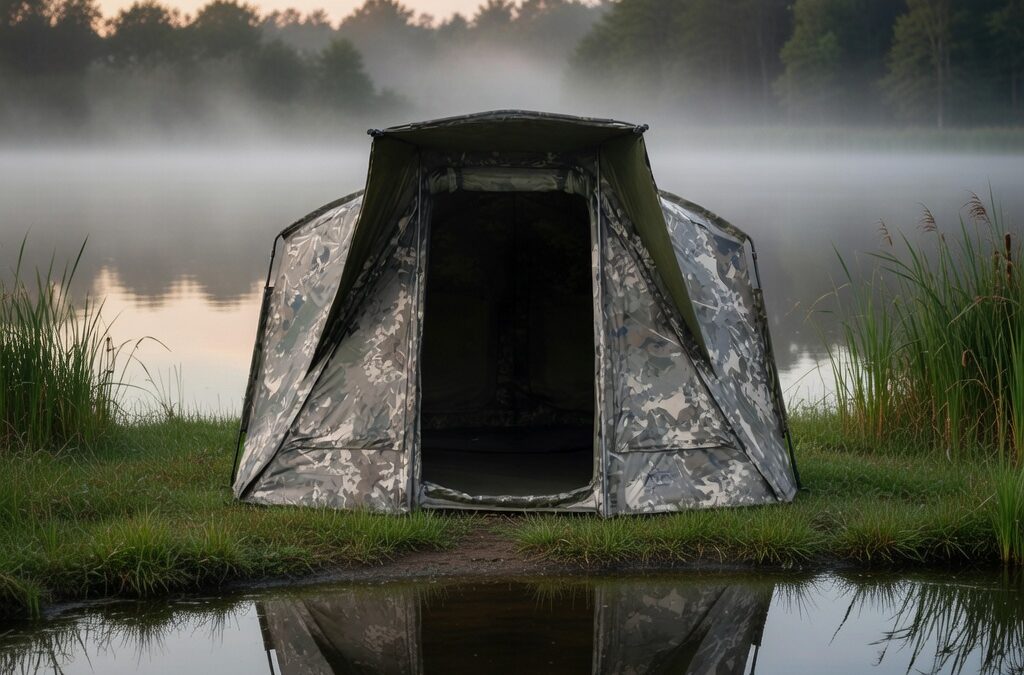
The Nash Titan T1 Camo Pro is the flagship 1-man bivvy from one of carp fishing’s most enduring and respected brands. At £674.99 on Angling Direct (down from the RRP of £799.99), it sits in the premium tier of 1-man bivvies — above the entry-level Fox EOS Pro and the budget Sonik AXS-V2, and below the professional-grade Trakker Tempest RS 150. That pricing position is deliberate: Nash has built something that competes hard on features, dimensions, and material quality, while remaining meaningfully more accessible than the £879.99 benchmark.
The headline story of the T1 Camo Pro is the height. At 183cm, this is one of the tallest production 1-man bivvies available in the UK market. If you are over 6 feet tall and have spent years crouching through bivvy doorways or sitting hunched on your bedchair staring at the fabric inches above your head, the T1 Camo Pro was built for you. But it’s not only about headroom — the redesigned frame system, four external climate panels, extended forward storm peak, and included inner mesh capsule combine to make this a genuinely capable all-season shelter that justifies its position in the Nash premium tier.
This guide covers everything you need to know before buying: the full technical specification, every feature explained in detail, what’s included in the box, how the frame system works, all compatible accessories, performance across all four seasons, comparisons with the key rivals, full pros and cons, and an honest verdict on whether the T1 Camo Pro deserves its price tag.
Nash Titan T1 Camo Pro — At a Glance
| Specification | Detail |
|---|---|
| Full Product Name | Nash Titan T1 Camo Pro Fishing Bivvy |
| Model Number | T4234 |
| Reference | NASH22090805 |
| Type | 1-Man Rigid Frame Bivvy |
| Outer Fabric | Aquasense (hard-wearing and breathable) |
| Waterproofing | 20,000mm Hydrostatic Head |
| Overall External Dimensions | H183cm × W276cm × D228cm |
| Door Height | 158cm |
| Inner Mesh Capsule Dimensions | H170cm × W252cm × D208cm |
| Storm Poles | 48″ – 82″ (adjustable) |
| Packdown Size | 142cm (L) × 36cm (W) |
| Complete Weight (inc. capsule & storm poles) | 16kg |
| Bivvy Only Weight (minus capsule) | 12.5kg |
| Inner Mesh Capsule Weight | 3.5kg |
| Optional HD Groundsheet Weight | 2kg |
| Climate Panels | 4 × double-zipped external panels |
| Inner Capsule | Removable mesh capsule with PVC base, included |
| Compatible Overwrap | Nash Titan T1 Camo Pro Overwrap (T4235) — £329.99 |
| Price (Angling Direct) | £674.99 (RRP £799.99) |
| Finance Available | From £22.73/month (0% APR) |
What’s In the Box
The Nash Titan T1 Camo Pro ships as a comprehensive package. Out of the carry bag — a single, structured bag — you get the complete bivvy with the rigid frame pre-assembled into the outer Aquasense skin, the four external climate panel storm covers, the removable inner mesh capsule (with PVC base), and the set of adjustable storm poles (48″–82″ range).
What is not included is a groundsheet. This is an important consideration before purchase: the Nash Titan T1 Camo Pro does not have a sewn-in or zip-in groundsheet as standard. An HD groundsheet is available as an optional extra (adding 2kg when carried). At this price point, the absence of an included groundsheet is the most notable omission — both the Trakker Tempest RS 150 (£879.99) and the Fox Frontier II X (£699.99) include groundsheets as standard. Nash has made a deliberate choice to keep the base price lower and allow anglers to add accessories as they need them. If you plan to use this bivvy for long sessions in damp or muddy conditions, budget for the groundsheet from the outset.
The inner mesh capsule’s inclusion is, by contrast, a genuine plus. Many competing bivvies — including the Fox EOS Pro and both Trakker Tempest 200 and RS 150 — charge extra for their inner capsules. Getting it in the box at this price represents real value.
The Nash Titan Legacy — Why the T1 Camo Pro Matters
Nash Tackle has been producing the Titan bivvy range for long enough that it has become one of the most recognisable silhouettes in UK carp fishing. The rigid frame design — a direct alternative to the fan-out rib systems used by Trakker and Fox — has earned the Titan a loyal following among anglers who value structural rigidity, weather resistance, and a fast-to-learn setup process.
The T1 Camo Pro is the latest evolution of that flagship product. Nash has described the redesign as being driven by “the evolving needs of the modern session carper” — which, in practice, translates to a set of specific improvements: greater height, better ventilation architecture, a more refined inner capsule, and an updated camo finish using the trademark Nash pattern.
The Camo Pro designation specifically refers to the armoured camo nylon outer construction — the same material used in the matching Camo Pro Overwrap (T4235, £329.99). This is a step up in material specification from the standard Titan T1, and it gives the Camo Pro range a visual coherence and a marginally more premium surface finish that holds up better to prolonged bankside use.
Aquasense Construction — The Outer Fabric Explained
The outer skin of the Nash Titan T1 Camo Pro is Nash’s proprietary Aquasense fabric. Nash describes it as “both hard wearing and breathable” — two properties that don’t always coexist easily in bivvy fabrics, and which Nash has worked to balance in the Aquasense construction.
The headline waterproofing figure is 20,000mm hydrostatic head. To put that in context: 10,000mm is generally considered the minimum for year-round UK use; 20,000mm is the premium standard used by most serious carp bivvies; and 25,000mm (as found in the Trakker Tempest RS range) is the current ceiling of mainstream bivvy waterproofing. The T1 Camo Pro’s 20,000mm rating is the same as that of the Fox Frontier II X (£699.99) and the Nash Titan Hide Camo Pro (£349.99). It is not the highest-rated fabric in the comparison set, but 20,000mm is genuinely sufficient for UK conditions including sustained winter rain — the theoretical column of water that would need to sit on the fabric before it begins to leak is 20 metres high.
The breathability component is important to understand because it affects condensation management. A non-breathable fabric traps warm, moist air inside the bivvy and forces it to condense on the inner surface of the skin, dripping onto your gear. A breathable fabric allows water vapour to pass through the weave from inside to outside, reducing this condensation effect before it becomes dripping water. In the T1 Camo Pro, the breathable Aquasense construction works in concert with the inner mesh capsule to create a two-stage condensation management system that is considerably more effective than either element alone.
The Nash Camo pattern on the outer surface is integrated into the production process and does not compromise the fabric’s waterproofing or breathability properties. The pattern — a dark, woodland-influenced design — blends naturally into reeds, trees, and bankside vegetation in a way that the green alternatives on competing bivvies do not.
The Rigid Frame System — How the Nash Architecture Works
Almost every mainstream carp bivvy on the market uses some variant of a fan-out rib system: a central hub from which ribs radiate outward and upward to create the dome shape. This is the approach used by Trakker (with their knuckle block) and Fox (with their ETS boss). Nash has long taken a different path with the Titan range: a rigid frame system that uses a pre-assembled pole-and-block structure rather than individual ribs fanning out.
The T1 Camo Pro features what Nash calls a “super strong Nash Titan centre block and fast assembly rigid frame.” In practice, this means the main structural element of the bivvy is a rigid, interconnected frame that you erect as a single unit — extending the poles to their locked positions within the frame rather than inserting individual ribs one by one.
The practical difference from the angler’s perspective is significant. On a traditional fan-out bivvy, you pick up each rib individually, insert it into the hub, and fan it out — a process that is generally fast but requires you to handle multiple separate poles in sequence. On the Nash rigid frame, the structure unfolds from its packed state in a more unified motion, which many anglers find more natural and less fiddly in low light or cold conditions.
A specific detail that Nash has clearly put thought into is the textured paint finish on the rib and storm poles. When you’re handling bivvy poles in wet conditions — cold, raining, with numb fingers — smooth poles are a genuine hazard. The textured finish dramatically improves grip. It’s a small design decision that makes a real practical difference when you’re setting up in a November downpour.
The frame’s structural rigidity means that, once erected and pegged, the T1 Camo Pro does not flex in the same way that fan-out designs can in strong winds. The outer Aquasense skin is held under consistent tension across the entire dome, which means rain runs off reliably rather than pooling in fabric sags.
The Extended Storm Peak — Design and Function
One of the T1 Camo Pro’s most practically useful features is its extended forward storm peak. This is the fabric extension that projects forward of the main door opening, providing a sheltered overhang above and in front of the entrance zone.
The purpose of a storm peak is threefold. First, it keeps rain off the door entrance, which means the ground immediately in front of your bivvy stays drier for longer — which in turn means less mud and water gets tracked inside on boots, waders, and landing net handles. On a 48-hour session with persistent rain, the amount of debris that comes inside via the entrance is significant, and anything that reduces it improves your quality of life on the bank.
Second, the extended design provides clearance for your vision. Nash specifically notes that the storm peak allows you to maintain visibility over the water from inside the bivvy, great when you need to survey for any showing fish. On rain-affected days when you’d otherwise need to open the door fully to check your rods, the extended peak lets you observe from a sheltered position.
Third, the storm peak provides a natural location for rod storage along the side of the bivvy during baiting up or when using spod and marker rods. The climate panel storm covers can be used to secure rods along the bivvy’s flanks, and the peak structure gives those rods additional protection from overhead rain.
The peak uses the adjustable storm poles (48″–82″ range) for support — a well-designed system that allows you to set the peak height and tension precisely for your swim’s ground level and your personal preference.
The 183cm Height Advantage — Why It’s a Game Changer
The Nash Titan T1 Camo Pro stands at 183cm. The door height is 158cm. These are not numbers that appear in isolation in a spec table — they are the single most distinctive feature of this bivvy and the primary reason many anglers choose it over competing products.
To understand why this matters, consider the competition. The Fox EOS Pro is 150cm high. The Sonik AXS-V2 is 137cm high. Even the premium Trakker Tempest RS 150 — the current benchmark 1-man bivvy — is 150cm high. At 183cm, the Nash T1 Camo Pro is 33cm taller than the Tempest RS and 46cm taller than the Sonik. That is a genuinely massive difference.
In practical terms: a 183cm bivvy height means that an angler of average or above-average height can walk through the door opening, stand up inside the bivvy, and sit on top of a full sleep system and look out over the water without the fabric pressing down on their head. You can dress and undress without performing contortions. You can stand up at night to deal with a run without banging your head on the frame. You can check your rods in a sitting position from your bedchair and actually see over the bivvy lip to the water surface — particularly valuable in the early morning when you’re checking for showing fish before making a cast.
The height is also psychologically significant for long sessions. Being in a space where you can move and breathe freely, rather than a cramped cocoon, makes the difference between a session that feels comfortable and one that feels claustrophobic by hour 36.
The trade-off is weight and packdown size. At 16kg complete and 12.5kg stripped, the T1 Camo Pro is meaningfully heavier than the 11.2kg Trakker Tempest RS 150. The packdown size of 142cm × 36cm is also larger than most competing 1-man bivvies. But for anglers who arrive at the lake by car and use a barrow, these are manageable numbers. The height advantage is, for many anglers, worth every kilogram.
Four Climate Panels — Ventilation Explained in Detail
The Nash Titan T1 Camo Pro features four double-zipped external climate panels — and this is genuinely one of the most sophisticated ventilation systems available in a 1-man bivvy at this price point.
Each climate panel is a section of the bivvy’s outer skin that can be opened via a double zip — top and bottom zips running along the panel’s edges. Opening both zips lifts the panel upward and outward, creating an opening in the bivvy’s wall through which air can flow. The interior of each opening is covered by insect-proof mesh, so even with the climate panels fully open you’re not providing direct access to mosquitoes and midges.
The folding strut supports are the key design innovation. These struts prop the lifted climate panel in the open position, held at an angle that allows airflow into the bivvy interior while simultaneously providing an overhang that prevents rain from entering the opening directly. This means you can run with climate panels open in showery conditions without rain coming inside — something that is not possible with simple open-panel designs. For UK fishing, where conditions change from sunshine to rain and back again within an hour, this ability to maintain ventilation during rain events is a significant practical advantage.
The nylon storm covers are the second layer of the climate panel system. These are separate covers that can be attached over the climate panel openings from the outside of the bivvy, without requiring you to go outside to do so. In extreme conditions — sustained horizontal rain, very cold winds — the storm covers close off the panels entirely, returning the bivvy to a fully enclosed state. In calm conditions, the storm covers come off and the climate panels breathe freely.
The storm covers also serve a secondary function: they can be used to store and secure rods along the flanks of the bivvy during baiting up. Rather than leaving rods propped against the bivvy or laid on the ground where they can be stood on, you slip them under the storm covers, which hold them close to the bivvy’s side.
Four panels — two on each side — give you a degree of directional control over airflow that single-vent or twin-vent systems cannot match. By opening the panels on the side from which the wind is coming and closing the downwind panels, you can direct the airflow through the bivvy’s interior, creating a cooling cross-breeze in summer without allowing excessive windchill. In very hot conditions, all four panels open simultaneously create the maximum possible through-ventilation.
The Inner Mesh Capsule — Condensation and Organisation
The Nash Titan T1 Camo Pro is supplied with a removable inner mesh capsule that fits within the main bivvy structure and serves two distinct purposes: condensation management and interior organisation.
On the condensation management side, warm air from your body and breath contacts the cooler inner surface of the Aquasense outer skin and condenses into drips. With the capsule fitted, your sleeping area is separated from the outer skin by a cavity — warm, moist air passes through the capsule’s mesh walls into that cavity, where it can escape through the outer skin’s breathability and the climate panel vents. Condensation drip that does form collects at the base of the cavity outside the capsule, not inside it. The PVC base of the capsule prevents any condensation that runs down the inner walls from pooling on your groundsheet inside the sleeping area.
The capsule’s dimensions — 170cm (H) × 252cm (W) × 208cm (D) — are generous. Even the largest standard carp sleeping systems fit comfortably within the capsule footprint, and you retain usable width either side for gear placement.
On the organisation side, Nash has equipped the capsule with a practical interior fitout. Twin elasticated mesh organiser pockets on the capsule walls provide immediate-access storage for essentials — phone, keys, headtorch, small tackle items. A central hanging hook is positioned for use with bivvy lights or insect zappers. Two additional hanging hooks, one on each side of the capsule, are positioned for receivers, clothing, head torches, and small bags.
The capsule is removable. In summer conditions, when condensation is not a concern and maximum interior volume and airflow are the priority, you can leave the capsule out entirely and use the full internal space of the T1 Camo Pro as your living and sleeping area.
The Flat-Back Profile — Maximising Internal Space
The Nash Titan T1 Camo Pro uses a flat-back profile design — the rear wall of the bivvy rises vertically, or very close to it, rather than curving inward as a dome would. This is a fundamental architectural choice that has significant consequences for usable internal space.
In a traditional dome-profile bivvy, the rear of the structure curves inward from the base to the apex, which means that the floor area near the back of the bivvy is always narrower than the widest point. If you slide your bedchair back to avoid rain pooling at the entrance, the back of your bedchair runs into the narrowing dome wall.
The flat-back profile eliminates this problem. The rear wall is effectively vertical, meaning the full floor width is maintained all the way to the back of the bivvy. In the T1 Camo Pro, that full width is 276cm — enough to accommodate even XL-wide carp sleep systems and still have room either side for kit storage.
The flat-back profile also allows the bivvy to be positioned closer to a rear bank, tree, or hedgerow — an important consideration on many carp swims where the bank immediately behind your position rises sharply or is covered by vegetation. A domed rear would catch on overhanging branches or need to be positioned further forward; the flat back sits cleanly against whatever structure is behind it.
Setup Guide — Step by Step
The Nash Titan T1 Camo Pro’s rigid frame system is different from the fan-out rib approach, and understanding the sequence before your first setup will save you time and frustration. Once learned — typically after one or two sessions — the process becomes fast and intuitive.
Step 1 — Choose your spot. The T1 Camo Pro’s footprint (276cm wide, 228cm deep) needs a clear, flat area. Orient the door toward the water. The flat back means you can position it directly against a bank or tree line without the structure catching.
Step 2 — Remove from the carry bag. The bivvy comes out of the bag in its collapsed but pre-assembled rigid frame form. Lay the unit flat on the ground along your front-to-back axis — the door end facing the water.
Step 3 — Erect the frame. Extend the rigid frame poles to their locked positions. The frame stands independently once erected — you don’t need a second person to hold anything while you manage the outer skin. The Aquasense outer skin rises with the frame as you extend it.
Step 4 — Orient and position. Check your door is facing the water and the bivvy is sitting where you want it before pegging. It’s significantly easier to slide the setup a foot to the left than to remove and replace pegs repeatedly.
Step 5 — Set the storm poles. Adjust the storm poles (48″–82″ range) to support the front peak at the desired height. The poles’ extended range accommodates varying ground slopes and personal preference.
Step 6 — Peg out the base. Working from the corners and alternating sides to maintain even tension, peg out all base pegging points.
Step 7 — Fit the inner capsule. Carry the inner mesh capsule inside and clip it to the frame’s internal attachment points. The capsule self-locates within the main bivvy space and zips closed to form the sleeping area.
Step 8 — Adjust climate panels. Depending on conditions, open the climate panel double zips to the desired level. In rain, prop them with folding struts. In dry conditions, remove storm covers for maximum airflow.
Total time from arriving to fishing: allow 10–15 minutes the first couple of times. Experienced users can typically complete the full setup in 8–10 minutes.
Packing away: Remove the inner capsule first and pack it separately into the carry bag. Lower the frame in reverse order, taking care with the pole joints in cold conditions. The carry bag is sized generously enough that repacking is straightforward even on a wet session.
Performance in Different Conditions
Winter and Heavy Rain
The Nash Titan T1 Camo Pro is a genuine four-season shelter. The 20,000mm Aquasense construction handles sustained UK winter rain comfortably. Close all four climate panels using the storm covers, zip the inner capsule closed, and the T1 Camo Pro creates a well-insulated, dry interior environment even in conditions that drive most anglers off the bank.
The flat-back design keeps the profile low and resistant to wind loading from the rear, while the rigid frame maintains structural integrity under wind pressure that would cause softer rib-based designs to flex. The extended storm peak keeps the entrance area notably drier than in bivvies without one — particularly important in winter, where tracking mud and water inside can make a long session genuinely miserable.
The inner capsule’s condensation management is most valuable in winter, when the temperature differential between inside and outside is greatest and condensation rates are highest. The twin-skin cavity the capsule creates between your sleeping area and the outer skin significantly reduces the drip condensation that is the most common winter bivvy complaint.
Autumn and Mixed Conditions
UK autumn is the hardest season for bivvy management — conditions can swing from 18°C sunshine in the afternoon to near-zero overnight, with rain arriving with little warning. The T1 Camo Pro’s four climate panel system is at its most impressive here. During the warm afternoon, run with all four panels open and the storm covers removed. As the temperature drops into evening, close the leeward panels and partially close the windward ones to reduce windchill while maintaining some airflow. When rain arrives at 2am, reach up and add the storm covers without leaving the sleeping bag.
Summer and Heat
All four climate panels open simultaneously, with storm covers removed, creates excellent through-ventilation in warm conditions. The inner capsule can be removed entirely to maximise internal volume and airflow. The 183cm height means the interior air volume is considerably larger than in lower bivvies, which reduces the greenhouse-style heat build-up that afflicts more compact structures during summer sessions.
One consideration in summer is that the T1 Camo Pro does not have a blackout lining. Bivvies like the Fox Frontier II X and the Advanta Session+ use blackout laminate lining that blocks solar heat gain and allows sleeping in after sunrise. If you’re a light sleeper or fish in swims with significant morning sun, this is worth noting.
Wind
The rigid frame system means the T1 Camo Pro performs better in strong winds than most fan-out bivvies of comparable size. The frame does not flex; the outer skin is held under consistent tension regardless of the wind direction; the structure does not breathe in and out in gusts the way less rigid shelters do. Guy ropes can be rigged to the pegging points for additional stability in exposed swims.
Compatible Accessories
Nash Titan T1 Camo Pro Overwrap — £329.99
The Nash Titan T1 Camo Pro Overwrap (model T4235, available from Angling Direct at £329.99) is the primary accessory for the T1 Camo Pro and the most impactful upgrade you can make for winter and shoulder-season fishing.
The overwrap uses the same armoured camo nylon construction as the T1 Camo Pro outer skin — Nash’s deliberate use of matching material gives the combination a visual and functional coherence. It wraps over the main bivvy structure, creating a second outer skin with a cavity between the two layers. This cavity provides meaningful thermal insulation by trapping a layer of still air — the same principle as double-glazing in a house.
The practical benefits are threefold. First, insulation: the cavity dramatically reduces heat loss through the bivvy skin overnight. Second, condensation: the outer surface of your main bivvy never gets cold enough to act as a condensation surface when the overwrap is fitted. Third, additional storage: the overwrap creates a covered space between itself and the bivvy’s front infill panel, providing a sheltered zone for buckets, waders, boots, and wet clothing — gear that would otherwise clutter the entrance or need to be left out in the rain.
The overwrap features a letterbox door arrangement that aligns with the main bivvy’s entrance, and comes with PVC daylight and storm door panels with elastic tie-backs. It comes with Nash T pegs and a carry bag as standard.
A fully-kitted T1 Camo Pro with overwrap will keep you comfortable in conditions that send lesser-equipped anglers home early. At £329.99, the overwrap is a substantial additional cost — bringing the total system investment to just over £1,000 — but for those who fish through winter, it is not optional equipment.
Nash Titan T1 Groundsheet (HD) — Optional Extra
The HD groundsheet adds 2kg to the carry weight but is strongly recommended for anyone using the T1 Camo Pro for sessions longer than a day or fishing in damp ground conditions. The absence of an included groundsheet is the T1 Camo Pro’s most significant standard-equipment omission at this price point, and filling that gap with the correct HD groundsheet from the outset — rather than using a thin universal groundsheet — is worthwhile.
Accessories Cost Summary
| Accessory | Price | Priority | When to Buy |
|---|---|---|---|
| Nash Titan T1 Camo Pro Overwrap (T4235) | £329.99 | ⭐⭐⭐⭐⭐ | Essential for winter / long sessions |
| Nash Titan HD Groundsheet | Budget separately | ⭐⭐⭐⭐⭐ | Essential — not included in bivvy price |
| Nash Titan Bivvy Pegs (10-piece set) | £19.99–£24.99 | ⭐⭐⭐ | Upgrade from standard pegs |
Nash Titan T1 Camo Pro vs Key Competitors
| Feature | Nash Titan T1 Camo Pro (£674.99) | Trakker Tempest RS 150 (£879.99) | RidgeMonkey XF2 Standard V2 (£1,299.99) | Fox Frontier II X (£699.99) |
|---|---|---|---|---|
| Capacity | 1-Man | 1-Man | 2-Man | 1-Man |
| Height | 183cm ✅ | 150cm | 190cm | 140cm |
| Outer Fabric | Aquasense (breathable) | Aquatexx | 300D HydroX | VenTec |
| Waterproofing | 20,000mm HH | 25,000mm HH ✅ | 300D ripstop | 20,000mm HH |
| Groundsheet Included | ❌ (optional extra) | ✅ Included | Sewn-in PVC ✅ | ✅ Included |
| Inner Capsule Included | ✅ Included | ❌ Sold separately | ✅ Included | ❌ Not available |
| Ventilation | 4 climate panels ✅ | 6-vent adaptive | Multi-vent + capsule | 4 vents (inside access) |
| Setup System | Rigid frame | Rapid Knuckle System | X-Frame (unfold) | Fan-out + ETS boss |
| Overwrap Available | ✅ £329.99 | ✅ Available | Porch extension | ✅ Available |
| Blackout Lining | ❌ | ❌ | ❌ | ✅ |
| Weight (bivvy only) | 12.5kg | 11.2kg ✅ | 27.5kg | 19kg |
| Packdown Size | 142cm × 36cm | 141cm × 25cm | 200cm × 42cm | 155cm × 23cm |
| Price | £674.99 | £879.99 | £1,299.99 | £699.99 |
The T1 Camo Pro’s most decisive advantage over every competitor is its height. At 183cm, it is 33cm taller than the Trakker Tempest RS 150 and 43cm taller than the Fox Frontier II X. For taller anglers, this alone settles the comparison. Its included inner capsule is also a meaningful advantage over the Trakker RS 150 and the Fox Frontier II X, both of which sell their capsules separately. At £674.99 — £205 less than the Trakker Tempest RS 150 — the T1 Camo Pro offers outstanding value for a premium-fabric, premium-height, 1-man bivvy with included inner capsule.
Where the Trakker RS 150 wins clearly is waterproofing (25,000mm vs 20,000mm), setup speed (the Rapid Knuckle System is the fastest single-action erection system on the market), and the included groundsheet. Where the Fox Frontier II X wins is the blackout lining, inside-accessible vents, and a marginally lower price at £699.99. But neither can match the T1 Camo Pro on height, and neither includes the inner capsule as standard.
Pros and Cons
| ✅ Pros | ❌ Cons |
|---|---|
| 183cm height — the tallest mainstream 1-man bivvy available | Groundsheet not included — must be purchased separately |
| 20,000mm Aquasense waterproofing — genuine all-season protection | Heavier than competitors at 16kg complete (12.5kg without capsule) |
| 4 external climate panels with folding strut supports — best ventilation control in class | Packdown size (142cm × 36cm) is bulkier than the Trakker RS 150 |
| Storm covers can be added/removed without leaving the bivvy | No blackout lining — can be warm/bright in summer mornings |
| Inner mesh capsule with PVC base included as standard | Overwrap (£329.99) is essential for winter but expensive |
| Flat-back profile maximises usable floor area | Single carry bag vs two-bag systems on some rivals |
| Extended storm peak — drier entrance, better visibility | |
| Textured pole finish for confident wet-weather handling | |
| Trademark Nash Camo Pro finish — outstanding bankside aesthetics | |
| Finance available at 0% APR from £22.73/month | |
| Currently on sale at £674.99 (15% off RRP of £799.99) |
Who Is the Nash Titan T1 Camo Pro For?
The T1 Camo Pro is built for a specific type of angler, and it’s worth being honest about who that is and who it isn’t.
It excels for taller anglers — anyone who has previously owned a standard-height bivvy and spent sessions feeling cramped or unable to move freely inside. If this describes you, the 183cm height is not a marginal improvement; it is a transformative one, and the T1 Camo Pro is the right bivvy for you almost regardless of the alternatives.
It excels for serious session carpers who want a four-season, all-conditions 1-man shelter with full ventilation control. The four climate panels, included inner capsule, and 20,000mm Aquasense fabric make this a capable year-round bivvy. Add the overwrap (£329.99) and it becomes a genuinely comfortable winter shelter.
It excels for anglers who fish in warm conditions and prioritise ventilation. No other 1-man bivvy at this price offers four independently controllable climate panels with rain-capable strut supports. In summer, the T1 Camo Pro is meaningfully better ventilated than its rivals.
It is less ideal for highly mobile anglers who move swims frequently. At 16kg complete and 142cm × 36cm packed, this is a bivvy for anglers who set up once and stay — arriving by car with a barrow, not walking the banks with a rucksack. The Nash Titan Hide Camo Pro (£349.99) at 6.5kg and sub-2-minute setup is the correct choice for mobile fishing.
It is less ideal for anglers who prioritise absolute top-end waterproofing. The Trakker Tempest RS 150 at 25,000mm HH is the market leader in waterproof rating, and if you fish in the most extreme UK winter conditions and demand the best-specified fabric available, the Trakker is worth the extra £205.
It is less ideal for budget-conscious beginners. The Sonik AXS-V2 at £289.99 and the Fox EOS Pro at £299.99 are better starting points for first-time overnight carpers who want to learn the ropes without a significant financial commitment.
Frequently Asked Questions
Does the Nash Titan T1 Camo Pro include a groundsheet?
No. The groundsheet is sold separately as an optional HD extra, adding 2kg when carried. This is the most significant omission at this price point compared to key rivals. Budget for the groundsheet from the outset — for long or damp sessions, it is not truly optional.
Does the inner mesh capsule come included?
Yes — the inner mesh capsule with PVC base is included as standard. This is a genuine advantage over several competitors, including the Trakker Tempest RS 150 and the Fox Frontier II X, which charge extra for comparable inner capsules.
Is the Nash Titan T1 Camo Pro suitable for tall anglers?
It is the best mainstream 1-man bivvy for tall anglers. At 183cm internal height, it is 33cm taller than the Trakker Tempest RS 150 and 43cm taller than the Fox Frontier II X. The 158cm door height means very tall anglers (over 6’2″) may need to dip slightly through the door frame, but once inside you stand comfortably upright.
How does the Camo Pro differ from the standard Nash Titan T1?
The Camo Pro uses an armoured camo nylon outer construction with the trademark Nash Camo pattern, which is a step up in material specification and finish from the standard T1. The matching Camo Pro Overwrap (T4235) uses the same armoured nylon, giving the Camo Pro system a consistent material across both bivvy and overwrap.
How long does the Nash Titan T1 Camo Pro take to set up?
Experienced users typically complete the full setup — including inner capsule and storm pole adjustment — in 8–10 minutes. Allow 12–15 minutes for your first two or three sessions while you familiarise yourself with the rigid frame system and pole locking sequence.
Can the Nash Titan T1 Camo Pro be used without the inner capsule?
Absolutely. Removing the capsule gives you the full 183cm × 276cm × 228cm interior space — ideal for summer sessions where condensation is not an issue and maximum airflow is the priority. The bivvy functions as a fully weatherproof shelter without the capsule; it simply loses the condensation-management benefit.
Is 0% finance available for the Nash Titan T1 Camo Pro?
Yes. Angling Direct offers 0% APR interest-free finance on the T1 Camo Pro. At £674.99 with a 5% deposit, a 6-month plan works out at approximately £106.87 per month. Check the current finance options directly on the Angling Direct product page.
Is the Nash Titan T1 Camo Pro worth buying with the overwrap at the same time?
For winter fishing, yes — the overwrap (£329.99) is effectively essential if you plan to fish through the colder months. The total investment of approximately £1,005 for bivvy plus overwrap compares favourably with the Trakker Tempest RS 150 at £879.99 for bivvy alone (inner capsule and overwrap still to add separately).
What is the model number for the Nash Titan T1 Camo Pro?
The model number is T4234 (product reference NASH22090805). The matching Camo Pro Overwrap is model T4235 (reference NASH22090811).
Verdict — Is the Nash Titan T1 Camo Pro Worth £674.99?
The Nash Titan T1 Camo Pro is, at its discounted price of £674.99, one of the best-value propositions in the premium 1-man bivvy market. For what you’re getting — 183cm internal height, 20,000mm Aquasense waterproofing, four independently controllable climate panels with folding strut rain protection, an included inner mesh capsule with PVC base, extended storm peak, rigid frame stability, and the trademark Nash Camo Pro finish — this is a bivvy that punches above its price bracket in almost every dimension that matters to a serious session carper.
Its weaknesses are real and worth acknowledging: no included groundsheet is an oversight at this price, the 16kg complete weight rules it out for mobile anglers, and the lack of a blackout lining is a minor but genuine gap compared to the Fox Frontier II X. The overwrap, at £329.99, is a near-essential addition for year-round fishing that brings the system cost above £1,000.
But for a tall angler who wants a spacious, well-ventilated, four-season 1-man shelter from one of carp fishing’s most respected brands — and who wants to spend £205 less than the Trakker Tempest RS 150 while getting a bivvy that is 33cm taller with an inner capsule already in the box — the Nash Titan T1 Camo Pro is the right answer. It is genuinely excellent, and at the current sale price of £674.99, it is also very good value.
View the Nash Titan T1 Camo Pro at Angling Direct — £674.99
For a comparison of the T1 Camo Pro against the best alternative bivvies currently available, read our full Top 10 Carp Fishing Bivvies for 2026 guide.
Last Updated on September 10, 2026 by Shane Stanford
Shane Stanford has fished for carp for over twenty years, in the UK and in France, and currently fishes a private syndicate water in West Sussex. He writes Fishing Again to put the things he learned the hard way into plain language: location and watercraft first, then bait, rigs and gear. He is straight about which kit he has actually fished and which he has assessed on specification, and says so on the page.


