Updated September 2026.
Homemade pop-ups follow the same logic as rolling standard boilies, with one extra variable to manage: buoyancy. Get that right and a base mix you already trust can be turned into a hookbait that sits proud of silt, weed or debris exactly where it needs to.
Cork Ball Versus Cork Dust Versus Pop-Up Mix
Whole cork balls pushed into a bait before boiling give strong, reliable buoyancy but leave a visible void once the cork dissolves or is removed, weakening the bait over time. Cork dust mixed through the paste itself gives a more even, durable buoyancy. Dedicated pop-up base mixes are formulated for this from the outset and are the simplest route for anyone not confident adjusting a mix by trial and error.
The Kit
Alongside the usual boilie-rolling kit, pop-ups need cork dust or a pop-up base mix, a microwave for finishing off buoyancy and drying, and a glass of water for testing. A smaller rolling table gauge is useful too, since pop-up hookbaits are often fished smaller than standard freebies.
Rolling and Microwaving
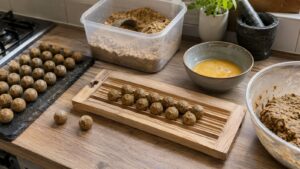
Roll pop-up paste exactly as you would a standard boilie, then boil briefly (30 to 45 seconds is usually enough, since these baits are typically fished small) before finishing with short bursts in the microwave. Microwaving drives off the remaining moisture and firms up the buoyant shell, and it is easy to overdo, so short bursts checked between each one avoid scorching the bait.
Testing Buoyancy
Drop a finished pop-up into a glass of water and watch how it sits. A bait that struggles to rise or sits low needs more cork or another round in the microwave; a bait that shoots straight to the surface and sits high is more buoyant than most presentations need and can be tempered by adding a very small amount of putty or heavier paste to the mix next time.
Colouring and Flavouring
Pop-ups take colour and flavour the same way as standard boilies, through the liquid stage before rolling. Bright colours are popular for pop-ups precisely because visibility, not food signal, is often the point of the hookbait, so do not be afraid to go bolder than you would with a bed of freebies.
Matching Pop-Ups to Your Freebies
A pop-up made from the same base mix as your freebies gives a matching hookbait that blends in; a pop-up in a contrasting colour and flavour stands out as an obvious single bait. Which approach suits depends on how pressured the water is and whether you want the hookbait to hide or announce itself.
Storage
Home-rolled pop-ups store less predictably than standard boilies, since the cork content can affect how they freeze and dry. Freezing in small batches and testing buoyancy again after defrosting avoids arriving at the bank with hookbaits that no longer float as expected.
For the base mix these are built from, see our guide to making boilies at home, and for choosing between pop-ups and other hookbait types on the day, our guide to wafters, pop-ups or bottom baits.
Read next:
- How to make your own boilies at home
- Wafters, pop-ups or bottom baits: which hookbait and when
- Boilie flavours explained
Last Updated on September 10, 2026 by Shane Stanford
Shane Stanford has fished for carp for over twenty years, in the UK and in France, and currently fishes a private syndicate water in West Sussex. He writes Fishing Again to put the things he learned the hard way into plain language: location and watercraft first, then bait, rigs and gear. He is straight about which kit he has actually fished and which he has assessed on specification, and says so on the page.