
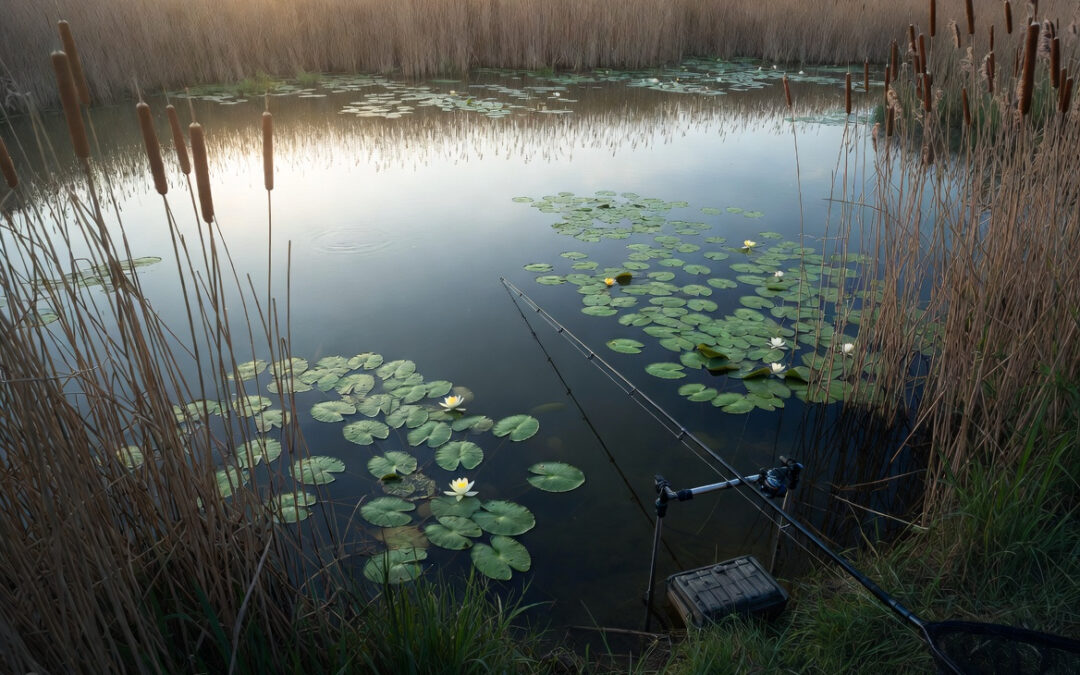
For a few weeks every late spring the carp in most UK lakes stop being fish you are trying to catch and become fish you are watching. Spawning is noisy, obvious and short, and the fishing on either side of it can be the best of the year. This is when it happens, how to recognise it, what to do while it is going on, and how to fish the weeks around it.
When carp spawn
Carp spawn when the water has held above roughly 17 or 18 degrees for a few days, usually after a warm spell in late May or June, though a cold spring pushes it into July and a hot one can bring it forward into mid May. Shallow, weedy, sun-warmed lakes go first; deep pits go last. The same lake will often spawn in two or three bursts a week or two apart as different groups of fish come into condition, and a sudden drop in temperature can stop it mid-way and restart it later.
What it looks like
You will hear it before you see it: crashing, splashing and thrashing in the margins, the reed beds, the lily pads and any shallow, weedy bay, typically starting around dawn and running through the morning. Several males chase a single female into the shallows and drive her through the weed as she releases eggs, which stick to the stems. The fish are oblivious to you, and you can watch from a few feet away. It is the one time you will see every big fish in the lake at once, which is why anglers who keep records make a point of being there with a camera and no rods.
Why you should not fish for them
A spawning carp has spent days without feeding properly and is burning everything it has. Fish caught during or immediately after spawning are prone to damage, to fungal infections in the scrapes and split fins they pick up in the weed, and, in the worst cases, to dying in the sling or on the mat. Many fisheries close for spawning, and the ones that do not usually ask anglers to reel in if fish are spawning in front of them. Do it without being asked. If you are on a water where it is happening, move to a swim where it is not, or take the hour to watch. The close season guide explains why lakes are open through this period at all.
Before spawning: the best fishing of spring
The two or three weeks before spawning are exceptional. The fish are feeding hard to build condition, they are in the warm shallows and margins, they are grouped up and they are less cautious than they will be all summer. Fish the shallows, the margins and the weed edges with bright pop-ups, small amounts of boilie and plenty of particles, and be on the bank at first light. The spring carp fishing guide has the full tactics.
After spawning: the recovery feed
Once it is over the fish are thin, hungry and ragged, and within a few days they feed with a lack of caution you will not see again until autumn. This is the time for quantity: beds of particles, hemp and boilie, fished on the spots the fish were using before spawning and in the deeper water off the spawning shallows where they go to recover. Hook holds are often poor on soft-mouthed, tired fish, so fish sharp hooks, keep the pressure steady, and give every fish extra time in the water before release. Keep the antiseptic to hand; almost every fish will carry a mark somewhere.
Reading the signs
If you are not sure whether it has happened yet, the fish tell you. Big, heavy females showing in the shallows in the evening mean it is close. Fish thrashing at dawn mean it is on. Ragged fins, red scrapes along the flanks and fish rolling lazily in open water afterwards mean it has been and gone, and the feeding window is open. Water temperature is the number to watch: a cheap thermometer on a length of cord will tell you more about the next fortnight than any forecast.
For where spawning sits in the wider year, the month-by-month carp fishing calendar ties it to the rest of the season.
Last Updated on September 10, 2026 by Shane Stanford
Shane Stanford has fished for carp for over twenty years, in the UK and in France, and currently fishes a private syndicate water in West Sussex. He writes Fishing Again to put the things he learned the hard way into plain language: location and watercraft first, then bait, rigs and gear. He is straight about which kit he has actually fished and which he has assessed on specification, and says so on the page.


